An expense is allowable only when it's incurred wholly and exclusively for the trade, so appearing on a typical business cost list doesn't approve the spend. The purpose at the time of purchase decides the answer, not the category on the invoice.
That distinction matters to UK sole traders, partners, company owners, and the accountants and bookkeepers who advise them. What follows works through that test as a decision, including mixed-purpose costs and the harder question of when an allowable expense is still money badly spent. Lesson 3 of Accountant She's expenses training, Expenses and strategic spending, covers the same point in more depth.
Table of Contents
- What allowable expenses mean in practice
- Apply the wholly and exclusively test
- Split business, personal and mixed-purpose costs
- Claim travel and vehicle costs with evidence
- Separate capital allowances from running costs
- Keep records that survive an HMRC question
- Key lesson takeaways and your next step
What allowable expenses mean in practice
A phone bill isn't automatically allowable. Neither is a train ticket, a desk, or software that every similar business buys.
Allowable expenses start with a narrower question. Why was this particular cost incurred, and was that reason entirely for the trade? A private reason sitting anywhere in the honest answer weakens the claim, however familiar the category looks.

Who needs this decision
Owner-managed businesses feel this most sharply because business and personal payments often leave the same bank account. A payment can look innocent when it's made, then become difficult to defend months later when nobody remembers why it was bought.
Sole traders and partners need to separate private use from business use. Limited company owners need a separate check on purpose, benefit and documentation. Advisers need a consistent way to ask clients for the missing facts before posting anything.
Why category headings fall short
Typical bookkeeping templates start with headings such as travel, phone, premises and office costs. Those headings organise your records well, and they stay silent on the harder cases. They say nothing when broadband is shared with family, when a journey begins at home, or when equipment is enjoyable to use privately.
Practical rule: Code the cost after deciding its purpose, not before. A tidy nominal code doesn't create tax relief.
Work the decision in this order instead:
- Purpose first: Apply the wholly and exclusively test to the actual purchase.
- Split what can be split: Identify a defensible business proportion where one exists.
- Choose the right route: Separate revenue costs, vehicle methods and capital items.
- Prove the decision: Keep records that still make sense during an HMRC enquiry.
- Spend strategically: Don't buy something unwanted just because relief might be available.
That last point deserves emphasis. Tax relief reduces the cost of something your business needs; it never justifies a purchase you'd skip otherwise.
The sequence turns a vague question into a repeatable review, and it prevents two opposite mistakes. A business can claim costs that shouldn't be claimed, or miss relief because a shared cost looks too complicated. Take home broadband as a worked example: the private use doesn't kill the claim, because a reasonable business proportion can still be identified and evidenced. The purpose test, applied carefully and backed by records, handles both risks.
Apply the wholly and exclusively test
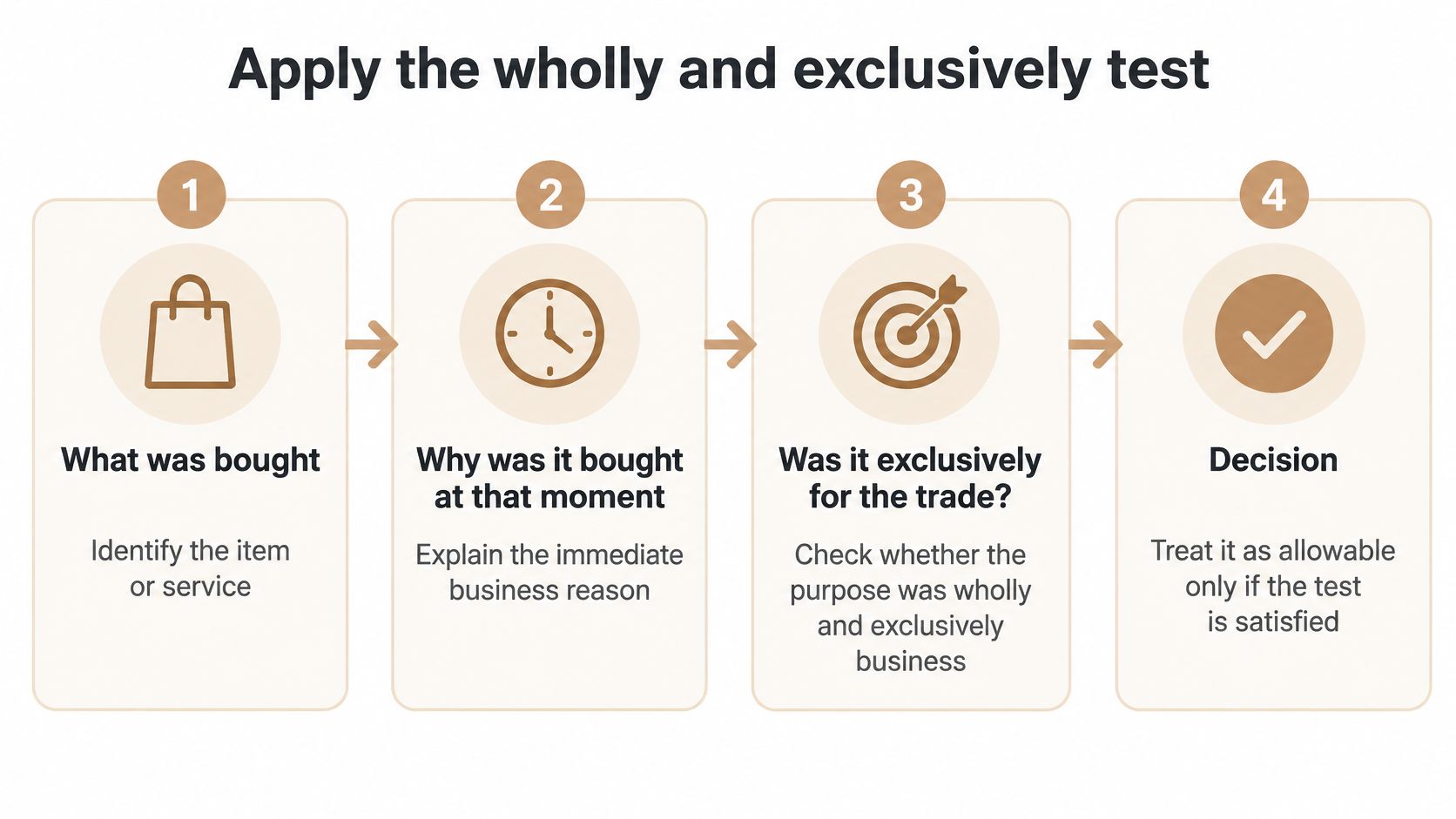
The test is a sequence, not a gut feeling. It begins with the purchase and ends with one of three outcomes: claim it, reject it, or apportion a clearly identifiable business part.
Work through four questions
- What was bought? Name the item or service precisely, including the period it covers.
- Why was it bought then? Record the immediate reason at the time, not a justification created later.
- Was the purpose exclusively commercial? Look for any genuine private purpose sitting beside the business purpose.
- Can a business part be identified? Decide whether part of the cost stands alone as wholly and exclusively for the trade.
For unincorporated businesses, the purpose test sits in section 34 of the Income Tax (Trading and Other Income) Act 2005, while companies use section 54 of the Corporation Tax Act 2009, as explained in HMRC's Business Income Manual on wholly and exclusively. Different legislation applies, but the practical question remains familiar. What was the taxpayer trying to achieve by spending the money?
Incidental benefit is not the same as dual purpose
An incidental personal benefit doesn't automatically spoil a claim when the underlying purpose stays exclusively commercial. A private purpose is different. Where expenditure has both a business and private purpose, the cost is generally disallowed rather than neatly apportioned.
That distinction protects sensible claims without opening the door to lifestyle spending. It also explains why two people can buy the same product and receive different tax answers. Their receipts may match, but their purposes may not.
The receipt shows what was paid. It doesn't explain why the business needed it.
A sound decision pack contains the invoice, a short business rationale, usage evidence and, for mixed-use items, a documented apportionment method. Premises, telephone services and software often need that extra note because the invoice alone rarely shows the business share.
The decision should be recorded while the facts are fresh. A short sentence attached to the transaction can save a long reconstruction later. General guidance works for routine purchases, but unusual benefits, director arrangements or disputed journeys need specific accounting advice before a claim is submitted.
Don't soften the answer to please the claimant. If the purpose isn't exclusively commercial and no separate business proportion can be identified, the professional answer is no.
Split business, personal and mixed-purpose costs
Most spending falls into three piles: wholly business, wholly private, and the awkward share in between. The first two take seconds. The third is where claims go wrong.
Run the mixed cost through a decision tree
Ask three questions in order. Was there a genuine business purpose? Can a business portion be separated from the private use with evidence? Can that portion be measured in a way that fits the facts? A yes at each step supports a claim. A no at the first step ends the discussion, and a no at either later step keeps the whole cost out.
Worked examples make this concrete. Broadband supporting client calls by day and household streaming at night can carry a business share measured by use. A dedicated business phone line passes every step. Family groceries fail at step one regardless of who paid.
Only a clearly identifiable business proportion can be claimed, and the method must be written down and supported by records. Business-related office costs, phone bills and premises costs can be allowable while private use is not, according to HMRC's expenses and allowances guidance for the self-employed.
A short note recording the basis, the period and the evidence used is enough. Room use might follow working hours and floor space. Phone use might follow itemised business calls. The method must fit the facts, not produce a convenient round claim.
Weigh the trading allowance against real costs
A sole trader or individual partner using the £1,000 trading allowance (HMRC's guidance on the trading allowance) can't also claim expenses for the same income. That choice needs a comparison, not an assumption that simplified means safer.
A partner with £6,000 of genuine home-office, software and travel costs should compare that total with the £1,000 allowance before choosing a route. Claiming actual costs wins there by a wide margin. A business carrying a few hundred pounds of costs should take the allowance and skip the apportionment work.
- Trading allowance route: Compare the allowance against the value of claiming no separate expenses.
- Actual cost route: Claim allowable expenses with apportionment notes and supporting records.
- Decision point: Model both with real working patterns, not a hope that costs stay low.
Spend only when allowable also means worthwhile
An allowable deduction reduces the tax bill. It doesn't make the spend free. A laptop that saves three hours a week earns its place before relief is counted, while the same laptop bought to replace one that works fine is allowable but still drains cash. Claim what the trade needs and let relief improve a sound decision rather than drive a poor one.
Company owners shouldn't copy a sole trader apportionment without checking the company position. Directors and employees face different benefit and reimbursement questions, so LTD Company Expenses Explained is the right route before a home or phone cost goes through a limited company.
Claim travel and vehicle costs with evidence
Travel turns on the journey, not on whether the traveller has work on their mind. Ordinary commuting between home and a permanent workplace is private, including related fares and meals.
Travel performed in the duties is different. Journeys between customers, travel from an office onward to a customer, and travel to a qualifying temporary workplace can support relief for transport, accommodation and meals when the statutory conditions are met.
Split the route into segments
A claimant should record the origin, destination, business purpose, workplace status and date for each leg. That level of detail matters because the home to office leg and the office to customer leg don't receive the same treatment.
Food needs the same discipline. Home-prepared food from ordinary domestic shopping isn't subsistence merely because it's eaten during a journey. Food bought during a qualifying business journey may be considered under the relevant rules, so the receipt needs the journey evidence beside it.
For deeper route and subsistence decisions, Travel and Subsistence Expenses Explained gives company and self-employed readers a focused next resource.
Choose mileage or actual vehicle costs
As checked for this 2026 guide, simplified mileage uses 45 pence per business mile for the first 833 miles and 25 pence for each subsequent mile, with motorcycles and scooters at 24 pence per mile, under HMRC's self-employed travel expenses guidance. Simplified expenses also cover working from home and living at business premises, but the vehicle choice has its own records and consequences.
| Question | Simplified mileage | Actual vehicle costs |
|---|---|---|
| What drives the claim? | Business miles recorded in a mileage log | Fuel, insurance, repairs, servicing and vehicle tax |
| What does it replace? | The actual running costs for that vehicle | No flat rate, because actual spending is analysed |
| What evidence matters most? | Dates, destinations, purpose and business miles | Receipts, invoices and a private-use adjustment |
| What can sit beside it? | Qualifying parking, tolls and congestion charges | Separate qualifying travel costs, subject to the rules |
Mileage replaces the need to calculate actual fuel, insurance, repairs, servicing and vehicle tax for that vehicle. That simplification only works with a reliable mileage record. Public transport, taxis, air travel, hotels and overnight meals can still form part of a qualifying travel claim.
Neither method wins permanently. Mileage, vehicle type, finance arrangements and private use can change the better answer over time, and switching methods may be restricted. Forecast before choosing, then review when the working pattern changes.
Separate capital allowances from running costs
A cost can pass the purpose test and still enter the tax calculation through a different door. The question changes from whether it’s for the trade to how relief is given.
Revenue spending versus capital spending
Everyday running costs include items consumed in operating the business, such as stationery, phone bills, fuel, parking, train fares and bus fares. Equipment, machinery and business vehicles bought under traditional accounting are generally dealt with through capital allowances rather than deducted in full as ordinary running costs, as set out in HMRC’s guide to expenses if you’re self-employed.
That distinction matters for vehicles. Actual vehicle costs involve private-use adjustments and may sit alongside the capital treatment of the vehicle. Simplified mileage follows a different calculation path. Mixing both approaches for the same vehicle creates messy records and a claim that’s difficult to defend.
Don’t ask only whether relief exists. Ask where the cost belongs in the accounts.
Cash basis and traditional accounting can also change the mechanics. A business should confirm which basis applies before assuming that an asset can be treated as a day-to-day expense. Changeable tax rules should be checked against the current HMRC position before figures are filed.
Common refusals and a clean split
Several costs fail before the capital question even arises:
- Fines: Don’t treat penalties from business driving or parking as ordinary motoring costs.
- Non-business journeys: Remove private mileage rather than absorbing it into a broad travel figure.
- Ordinary commuting: Keep home to permanent workplace travel out of the claim.
- Inseparable dual purpose: Reject spending where a genuine private purpose can’t be separated from the business purpose.
Where a business proportion is identifiable, the split should be visible. A shared phone claim might show the total bill, the business calls identified from the itemised record, and the resulting business element. The private remainder stays out. No new theory is needed when the calculation can be followed from invoice to claim.
Readers deciding where equipment or a vehicle belongs should use the resource that matches their business structure. LTD Company Expenses Explained suits company owners, while Sole Trader Expenses Explained suits unincorporated businesses. Using the wrong structure as a template can produce the wrong treatment even when the purchase itself is sensible.
Keep records that survive an HMRC question
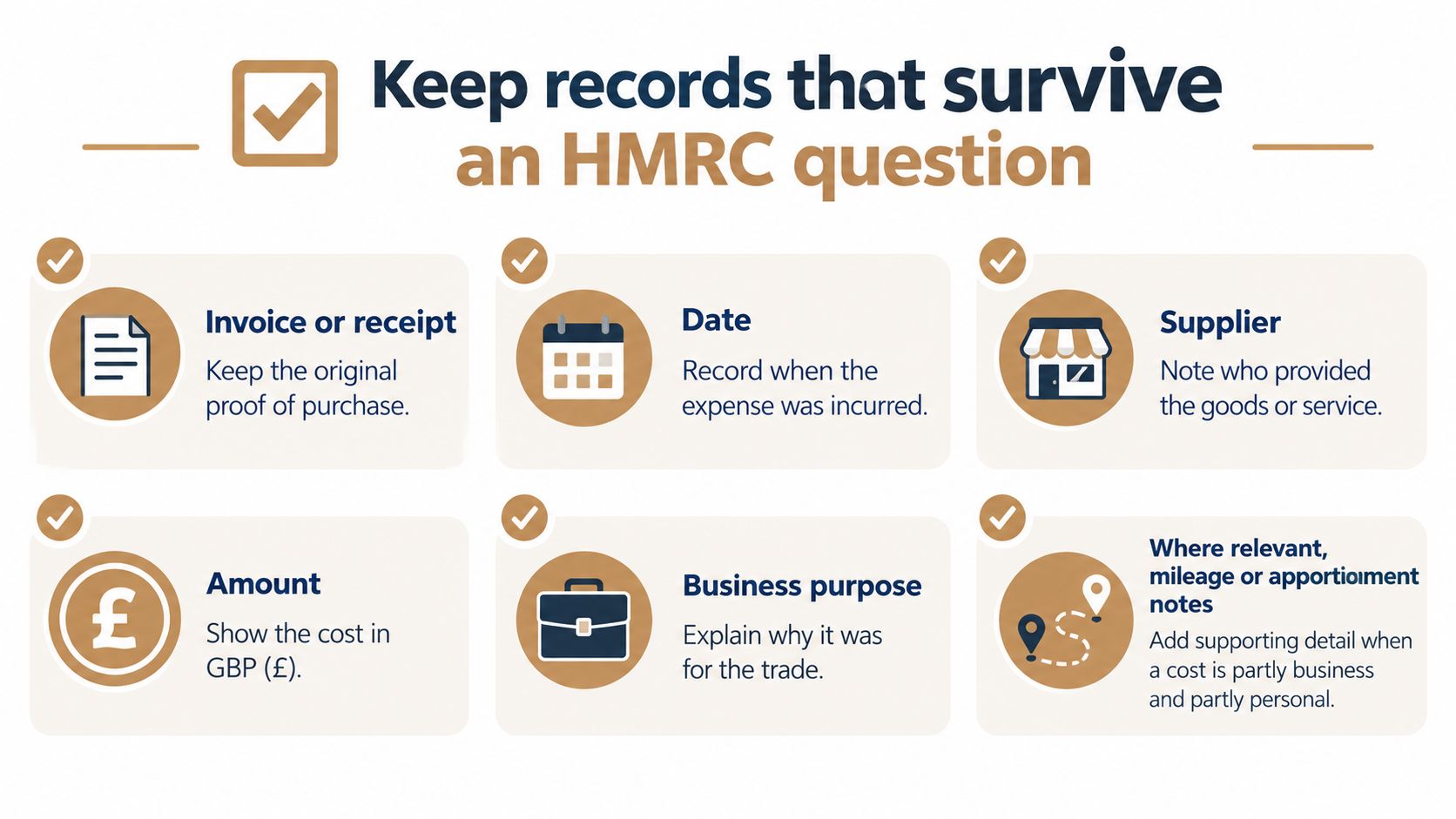
A correct decision isn’t much use if nobody can prove it eighteen months later. Records need to show both payment and purpose.
Build the evidence pack at source
For routine spending, keep the invoice or receipt, date, supplier, amount and business purpose together. Travel claims also need origin, destination, workplace status and supporting receipts. HMRC treats ordinary home to permanent workplace commuting as private, while travel in the duties can support relief when conditions are met, as HMRC’s Employment Income Manual on travel expenses explains.
That record exposes weak claims early. A neat supermarket receipt doesn’t turn home-prepared food into subsistence. A train ticket doesn’t override the commuting boundary. The evidence must answer why the cost belongs to the trade.
Mixed-use costs need one extra layer:
- Premises: Note the room, working pattern and basis used to reach the business share.
- Phone and broadband: Keep bills and identify business use from a realistic source.
- Software: Record users, business function and any private use that has been removed.
- Review period: State when the apportionment starts and when it will be reconsidered.
Handle VAT and digital records practically
VAT is a separate question from deductibility. A bookkeeper should know whether VAT is being reclaimed, whether a valid VAT invoice is held, and whether private use affects the amount. No claim should be posted from a card statement alone when the underlying invoice is missing.
Making Tax Digital doesn’t replace the business rationale either. Digital records should preserve the invoice, the categorisation and the short purpose note in one trail. A spreadsheet total without the story behind it won’t survive detailed questioning.
Before posting, use the same five checks every time. Confirm the business purpose, remove private use, choose revenue or capital treatment, select mileage or actual vehicle costs where relevant, and compare the trading allowance where that choice exists. Working Papers for Sole Trader Accounts can help turn those checks into a repeatable file review.
Key lesson takeaways and your next step
The lesson is deliberately unsentimental. Two invoices for the same laptop can produce different answers if the purpose differs, so record that purpose on each one.
Run a pre-filing check
The decision tree settles whether a cost qualifies. Before filing, three actions sit outside it:
- Match every mileage claim against the log, and remove trips that can’t be tied to a business journey.
- Confirm an apportionment note exists for every mixed-use item, stating the basis and the date it will be reviewed.
- Record the reason the trading allowance was rejected where actual expenses were claimed instead.
The figures worth remembering are 45 pence and 25 pence for simplified car mileage, and 24 pence for motorcycles, all set out in HMRC’s self-employed travel expenses guidance. The trading allowance comparison for eligible sole traders and partners works the same way: it earns its place only once the actual-expenses total is known. No figure should be lifted from this guide and applied without checking the business structure, accounting basis and the current HMRC position.
Allowable doesn’t mean worthwhile
Strategic spending asks a second question after the tax test passes. Does the purchase improve delivery, capacity, quality or time use enough to justify the cash leaving the business?
Tax relief can reduce the cost of a good decision. It doesn’t turn an unnecessary purchase into a good one.
That question stops year-end spending for its own sake. Approve the commercial case first, confirm the expense treatment second, and keep the evidence from the start. I would challenge any purchase where tax relief is the only benefit anyone can describe.
This guide can’t decide a specific HMRC enquiry, company benefit, leased vehicle or unusual working arrangement. Those cases need advice on the full facts. Routine purchases become much easier when purpose, split, route and records are handled in that order.
Company owners should continue with LTD Company Expenses Explained for the limited company position. Sole traders should use Sole Trader Expenses Explained to apply the test to self-employed allowable expenses and what expenses can be claimed when self-employed. Pick the route that matches the business, then review one month of spending against the decision tree before the next claim is posted.
Accountant She Ltd provides practical online training, courses, templates and resources for UK accountants, bookkeepers, practice owners and business founders who want clearer systems and stronger technical confidence.