A company payment isn't automatically an allowable expense. The better question is, why are you spending it, who benefits, and what evidence supports the claim? This guide helps UK company directors and practice owners apply that test to limited company expenses, separate ordinary running costs from capital purchases, and spot costs that need payroll, benefit or accountant review.
That matters because Corporation Tax is charged on taxable profit, not turnover. Allowable business deductions reduce the profit used in the calculation. HM Revenue & Customs recorded £192.3 billion of qualifying capital expenditure in 2024 to 2025, compared with £187.1 billion in 2023 to 2024, while capital allowances claims after balancing charges totalled £155.0 billion in 2024 to 2025. These figures show why expense treatment is more than a bookkeeping detail. HMRC's Corporation Tax statistics show the scale of decisions being made across the corporate economy.
The practical route is simple: understand the tax distinction, ask why the company incurred the cost, keep a clear evidence trail, and flag mixed-use or unusual items for review. A reliable record is more useful than an overconfident list of expenses.
Table of Contents
- What limited company expenses mean for directors
- How allowable business expenses reduce taxable profit
- The why are you spending it test for every claim
- Common allowable costs and costs you cannot claim
- Worked examples for travel mileage staff benefits and home costs
- How to record review and claim expenses with confidence
- Key lesson takeaways and your sensible next step
What limited company expenses mean for directors
Limited company expenses are costs paid or incurred by a company in carrying on its business. A revenue cost may reduce taxable profit if it was incurred wholly and exclusively for a business purpose and isn't specifically disallowed. A capital purchase usually follows a different route, with relief considered through capital allowances rather than a direct deduction.
That definition serves two groups. Directors need a practical way to decide what belongs in the company records, while accountants and practice owners need a consistent framework for reviewing claims and explaining decisions to clients. The same framework applies whether the cost is a routine subscription, a journey to a client, a laptop, a professional fee or a director's reimbursement.
The question behind every claim
Rachel Harris's most useful test is direct:
“Why are you spending it?”
The answer should identify the commercial purpose, not merely describe the item. “The company bought a phone” isn't enough. The record should show who uses it, how it's used for the business, whether there's private use, and whether any benefit or payroll treatment follows.
A company is legally separate from its directors and shareholders. Paying a personal cost from the company bank account doesn't turn it into an allowable business expense. Depending on the circumstances, the payment may instead be a reimbursement, salary, director's loan or taxable benefit. HMRC's guidance on taking money out of a limited company explains why personal use of company assets can create reporting and tax consequences.
A useful mental model
Every claim has three parts:
Purpose: why the company incurred the cost.
Proof: the invoice, receipt, mileage record or other evidence.
Treatment: revenue deduction, capital allowance, reimbursement, payroll item, benefit or disallowed cost.
Keeping those parts together makes year-end review more efficient. It also helps directors avoid the common mistake of assuming that a commercially sensible purchase is automatically tax deductible.
How allowable business expenses reduce taxable profit
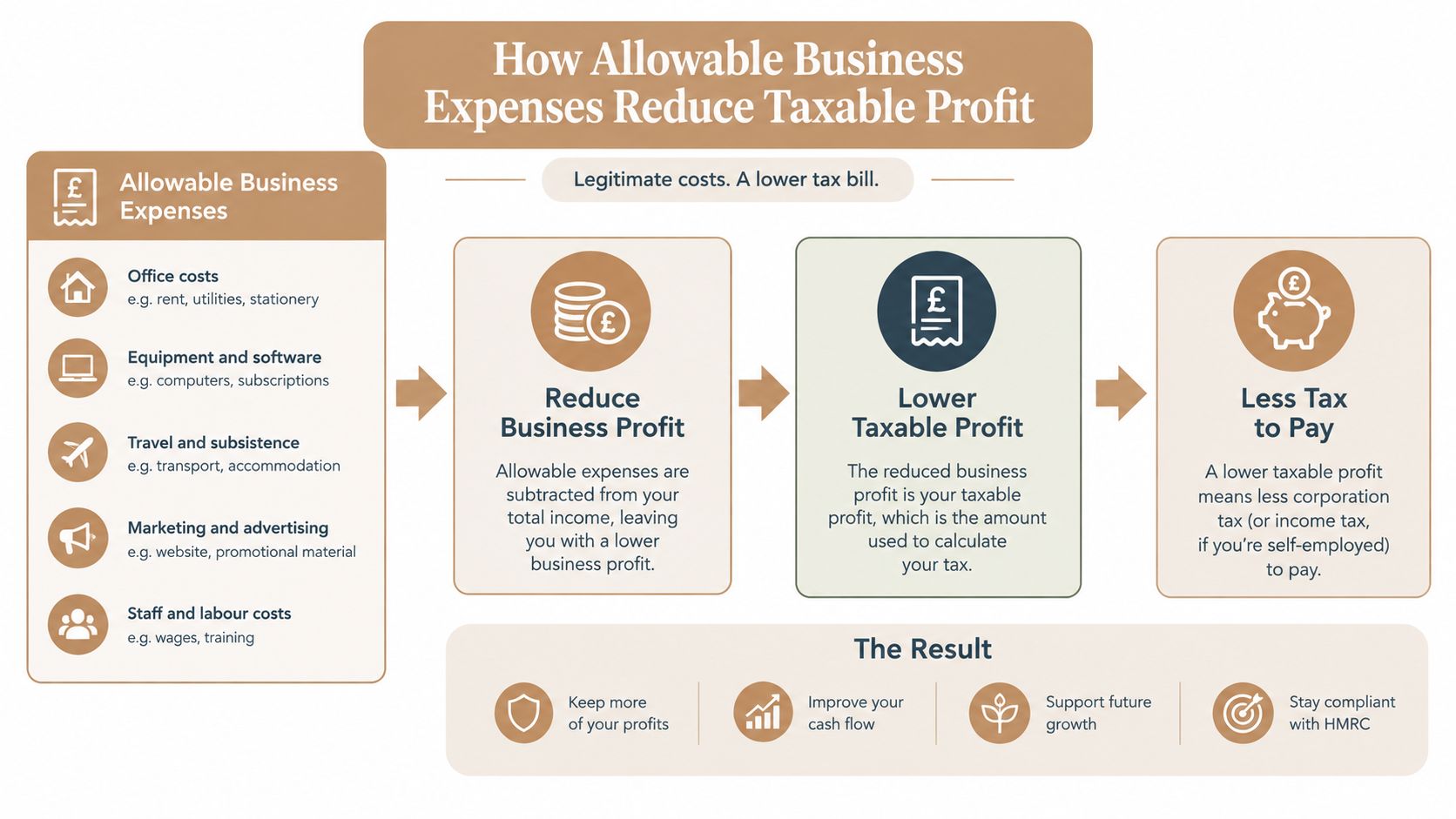
An allowable revenue expense reduces the profit on which Corporation Tax is calculated. It doesn't reduce turnover, and it doesn't mean the company receives the whole cost back. The tax effect depends on the company's taxable profit and the applicable rules.
The starting point is the wholly and exclusively test. The cost must have been incurred for the company's business purpose. If private use forms part of the cost, the business element may need to be separated, or the item may require benefit reporting. HMRC's guidance on company expenses that can be deducted before paying Corporation Tax also confirms that some costs are specifically disallowed, including client entertaining.
Revenue and capital are not interchangeable
Revenue expenditure relates to the day-to-day running of the company. Examples can include ordinary office costs, business insurance, professional fees and qualifying travel. These costs are normally considered in the Corporation Tax computation when the relevant conditions are met.
Capital expenditure relates to acquiring or improving an asset retained for business use. Equipment, machinery and business vehicles can fall into this category. A capital item generally isn't deducted directly as an ordinary expense, but the company may be able to claim capital allowances under the relevant rules. HMRC explains the distinction in its guidance on capital allowances and reliefs.
Depreciation illustrates why the accounting and tax records need to connect. Depreciation is an accounting charge, but it isn't itself an allowable tax deduction. The tax computation may replace it with capital allowances where the asset and expenditure qualify.
Why classification changes the result
Treating a capital purchase as an ordinary expense can understate taxable profit. Failing to identify an available capital allowance can have the opposite effect and leave taxable profit overstated. Neither outcome is fixed by the fact that the payment left the business bank account.
A practical expense schedule should separate:
recurring operating costs;
asset purchases and improvements;
private or mixed-use amounts;
costs needing payroll, benefit or director's loan review.
The UK moved from a single Corporation Tax rate of 19% to a main rate of 25% on 1 April 2023, while introducing a 19% small-profits rate and marginal relief. The interaction between profit levels, classification and reliefs means that accurate records matter particularly for companies near the relevant small-profits or marginal-relief thresholds. Directors seeking a structured refresher can use this limited company accounts and Corporation Tax blueprint.
The why are you spending it test for every claim
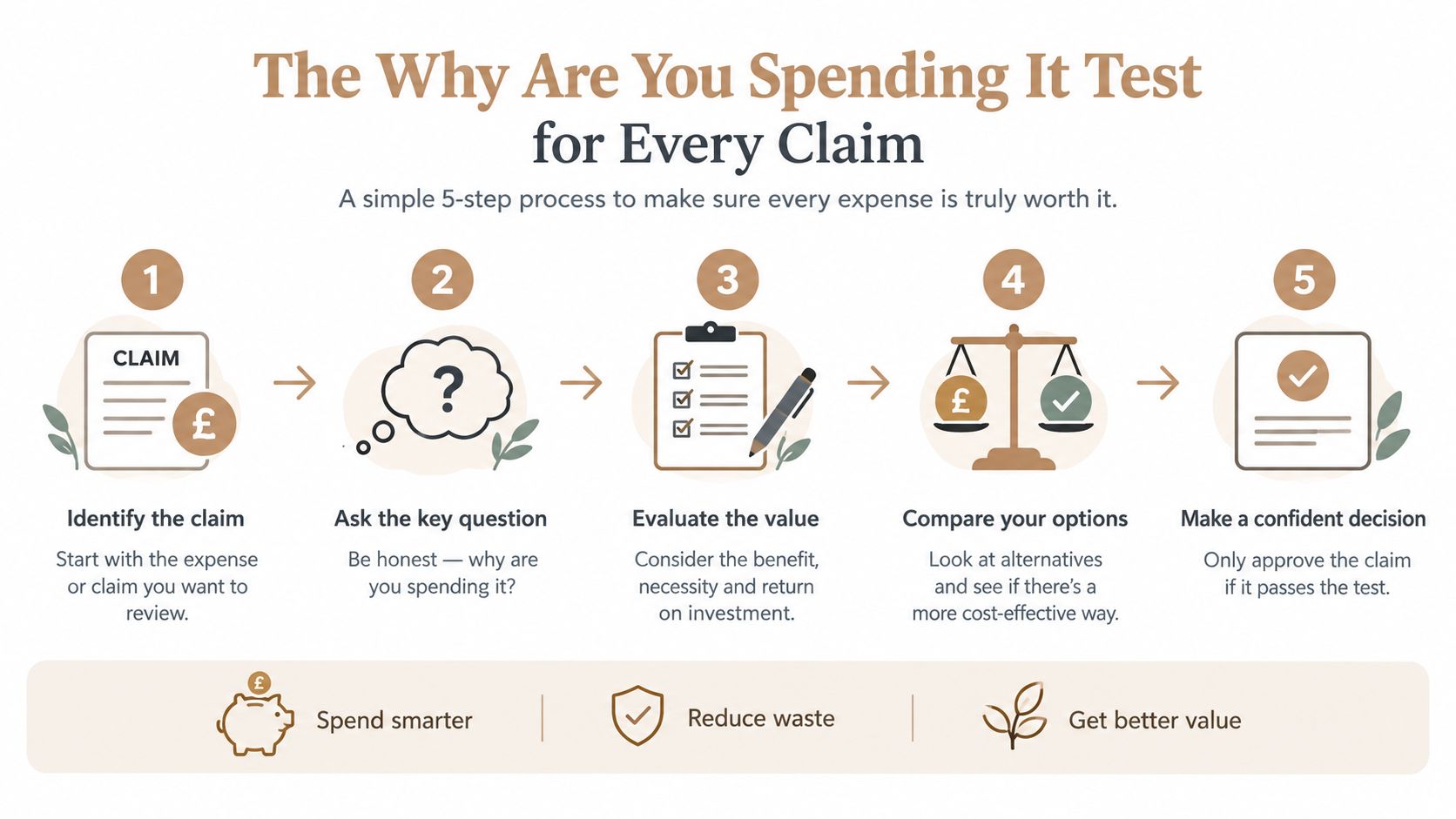
A director can apply the test before the transaction is posted. The aim isn't to create paperwork for its own sake. It is to decide whether the company paid for a genuine business cost, whether private use is present, and whether the payment belongs in the expense accounts at all.
Start with four questions:
Who incurred the cost? Was it the company, an employee or the director personally?
Who benefited? Did the business receive the benefit, or did an individual also receive private use?
What proportion was private? Can the business element be identified and supported?
What reporting follows? Does the item need reimbursement records, payroll treatment, a benefit report or director's loan review?
Company cost, personal cost or reimbursement
If the company buys an item used entirely for the business, the record is relatively clear. If a director pays personally for a business cost, the company may reimburse the director, provided the original cost satisfies the business-purpose test and the company keeps the supporting evidence.
A mixed-use item needs more care. A mobile phone, computer, vehicle, home cost or professional subscription may support the business while also providing private benefit. The company should identify the business purpose, consider the private element and check whether a benefit in kind or another reporting obligation applies.
Family-related spending is a clear review flag. A payment doesn't become allowable because it feels connected to the director's personal circumstances. If the company has paid a private cost, it may need to be recorded outside the normal expense deduction and dealt with through the appropriate account or payroll route.
The bank account test is not enough
A company bank statement proves that a payment was made. It doesn't prove that the payment is tax deductible. The invoice, business purpose and treatment still need to be established.
Sole traders may have access to simplified expense rules in certain circumstances. A limited company can't automatically use those rules because the director works alone. The company remains a separate legal person, and its records need to reflect that separation.
Review flag: If a cost has both business and personal value, the claim shouldn't be approved from the bank statement alone.
Cars, home costs, technology and subscriptions often deserve an accountant review where the private proportion isn't obvious. The same applies to payments that could be salary, a benefit, a reimbursement or a director's loan. A short note made when the cost is incurred is usually more useful than a reconstruction at year end.
Common allowable costs and costs you cannot claim
Most routine business spending is easier to classify once the purpose is clear. Office running costs, qualifying travel, business insurance, professional fees, software and employee costs can commonly form part of the company's revenue expenditure, subject to the conditions applying to the specific item.
Capital purchases need a separate line of thought. Equipment, machinery and business vehicles may qualify for capital allowances, but they shouldn't automatically be posted as ordinary revenue costs. Client entertaining is different again. HMRC treats it as specifically disallowed, even if the company paid for hospitality connected with business activity.
Companies House charges also belong in the fixed-cost budget. From 1 February 2026, digital incorporation costs £100, a digital confirmation statement costs £50, and paper filing of annual accounts costs £110, according to the Companies House fee changes. A company filing one confirmation statement and paper annual accounts would therefore face listed Companies House charges of £160, before accounting, payroll, software, insurance or professional-adviser fees. If same-day digital incorporation through approved software is added, the three transactions total £316.
| Spending example | Likely treatment | Evidence needed |
|---|---|---|
| Office stationery or ordinary software | Revenue cost where incurred for business use | Supplier invoice and business purpose |
| Business insurance or professional fees | Revenue cost where wholly and exclusively for the company | Policy, invoice and payment record |
| Equipment, machinery or a business vehicle | Capital treatment, with capital allowances considered where available | Invoice, asset details and business-use records |
| Client entertaining | Disallowed for Corporation Tax purposes | Invoice and attendee or purpose note, for accurate records |
| Mixed-use phone, technology or home cost | Business element may need separation, with private use reviewed | Invoice, apportionment method and usage explanation |
| Companies House filing fee | Administrative company cost, with accounting treatment reviewed in context | Companies House receipt and filing record |
A training cost needs the same “why” question as any other purchase. The business purpose, connection with the work and evidence of the spend should be recorded. For a broader commercial framework when assessing whether training spending delivers value, directors may find this guide to training ROI for L D useful. It supports the business decision, but it doesn't replace the tax classification.
Worked examples for travel mileage staff benefits and home costs
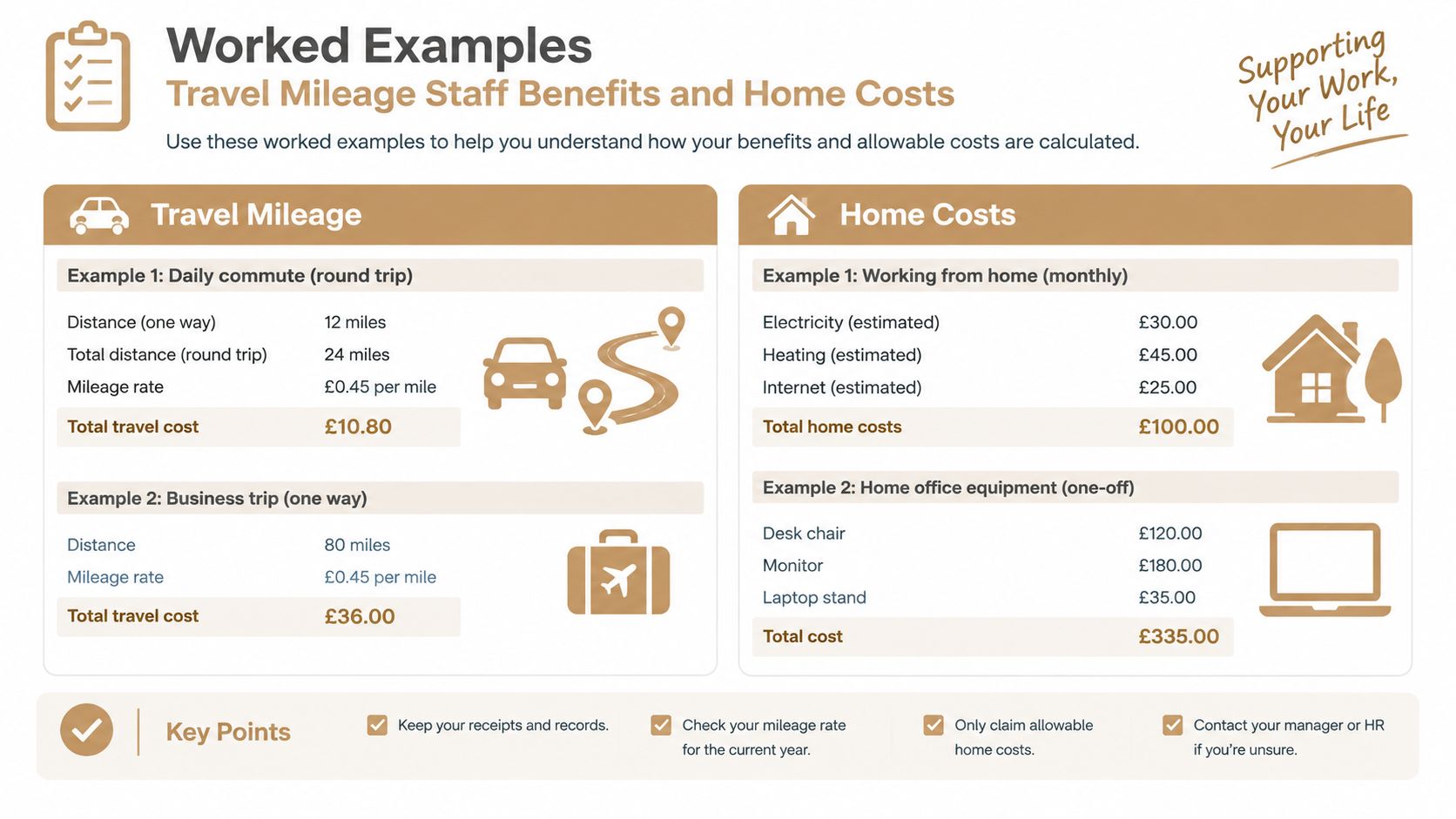
Worked checks help directors catch errors before a reimbursement reaches payroll or the accounts. The figures below are based on the relevant rate or exemption rules, and they should be date-stamped because rates can change.
Mileage needs the vehicle and date
For employees using their own cars or vans for business travel, the approved mileage rate applying before 6 April 2026 is 45 pence per mile for the first 10,000 business miles in a tax year and 25 pence per mile above that level. From 6 April 2026, the first 10,000-mile rate for cars and vans rises to 55 pence, while the rate above 10,000 miles remains 25 pence. HMRC's mileage guidance should be checked for the applicable period.
For example, a car journey of 100 business miles before 6 April 2026 would be checked by multiplying 100 by £0.45. The same journey from 6 April 2026 would use £0.55, assuming the mileage falls within the first 10,000 business miles.
Motorcycles use 24 pence per mile, and bicycles use 20 pence per mile, under the stated approved rates. A mileage log should show the date, route, business purpose, vehicle type and miles. If the company pays more than the approved amount, the excess can create taxable income for the employee.
Small benefits have a hard boundary
The trivial-benefits exemption is limited to £50 per employee for each benefit, using the VAT-inclusive cost. The benefit must not be cash or a cash voucher, a reward for work or performance, or part of the employee's contractual terms. HMRC's research on benefits in kind and expenses confirms that if the cost exceeds £50, the full amount becomes taxable rather than only the excess.
That creates a simple check. A non-cash benefit costing £50 per employee may qualify if all other conditions are met. A benefit costing £51 doesn't qualify for partial relief under this exemption, so the full amount needs to be considered for tax and reporting.
Home costs need a business-purpose record
Home-working costs can be mixed. A company should identify what the business needs, who paid the cost, whether the company bought an asset, and whether private use is present. A home office purchase may be capital rather than revenue, while a shared household cost may require a defensible business apportionment.
Directors can use the travel and subsistence expenses guide alongside the mileage record. It helps keep journeys, subsistence and supporting evidence together rather than treating every payment made during travel as automatically allowable.
How to record review and claim expenses with confidence
A sound process starts before the year-end accounts. Each month, the company should capture the receipt or invoice, record the payment date, identify the claimant and add a short note explaining the business purpose.
The review then follows a consistent order:
Match the evidence: Check that the invoice or receipt identifies the supplier, date, amount and item.
Classify the cost: Decide whether it is revenue, capital, mixed use or disallowed.
Record the purpose: Add enough detail for another person to understand why the company incurred it.
Check the claimant: Reconcile employee reimbursements and director-paid costs separately from company-paid expenses.
Escalate exceptions: Flag private use, entertaining, assets, unusual benefits and unclear apportionments.

A clean review pack
A useful accountant pack should contain the expense ledger, missing-evidence list, asset schedule, mileage logs, reimbursement analysis and notes on anything requiring judgement. Directors should also reconcile amounts due to or from them, particularly where personal payments and company payments have been mixed.
The process should make errors visible. Common warning signs include missing invoices, mixed-use costs posted in full, client entertaining treated as deductible, and capital items placed in ordinary expense codes. An expense policy can set out what information employees must submit and how directors approve exceptions. Businesses looking to streamline expense claim approvals can use a documented workflow rather than relying on informal messages.
Records should be kept in a way that supports the company's accounting and tax obligations. A working-paper structure can help directors and advisers assemble the evidence consistently, and working papers for limited company accounts provide a focused route for organising that review.
A good expense record answers three questions without a follow-up email: what was bought, why the company needed it, and how the tax treatment was decided.
Advice suited to your situation is sensible where a cost has substantial private use, an asset has been improved, a director's loan may be involved, or a benefit needs payroll reporting. Those are judgement points, not bookkeeping shortcuts.
Key lesson takeaways and your sensible next step
The strongest expense process doesn't begin with an alphabetised list. It begins with purpose.
Ask why the company is spending: A business payment needs a commercial explanation.
Separate revenue from capital: Ordinary running costs and long-term assets follow different Corporation Tax routes.
Apply wholly and exclusively: Private use needs apportionment or benefit review where appropriate.
Don't rely on the bank statement: Payment from the company account doesn't prove deductibility.
Keep evidence close to the transaction: Invoices, receipts, mileage logs and purpose notes make review easier.
Check the boundaries: Mileage rates, trivial benefits, entertaining and home costs can produce different reporting outcomes.
Escalate judgement calls: Directors, accountants and practice teams should review mixed-use, capital and personal expenditure before finalising the claim.
The practical habit is to pause before posting a cost and ask, “Why are you spending it?” If the answer is clear, the evidence supports it and the treatment matches the purpose, the record is much more likely to stand up to review.
Directors who want a more structured resource can use Accountant She Ltd's LTD Company Expenses Explained guide to work through common claims, evidence and review points. It should complement, not replace, advice suited to the company's actual circumstances.
Accountant She Ltd provides online accountancy training, courses, templates and resources for accountants, bookkeepers, practice owners and business founders.