Choosing between a sole trader and a limited company affects far more than the wording on an invoice. It changes who carries the business risk, how profits reach the owner, what records must be filed, and how easily the organisation can employ people or retain cash for growth. This guide is for freelancers, contractors, first-time employers and founders deciding whether they should go limited now or change structure later.
There isn't one structure that wins for everyone. A low-risk freelancer who needs nearly all profits personally may value simplicity more than incorporation. A founder signing larger contracts, taking on staff or borrowing money may reasonably accept extra administration in exchange for legal separation and a more formal operating structure.
Table of Contents
- The choice behind sole trader vs limited company
- How UK founders actually choose between the two structures
- Legal status, liability and everyday admin obligations
- Tax, National Insurance and how money actually leaves the business
- Worked scenarios showing when incorporation pays off
- What limited liability actually protects, and what it does not
- Your decision checklist, key lesson takeaways and next steps
The choice behind sole trader vs limited company
The right structure depends on what the business must handle next. It affects the risks you accept, how profits reach you, the records you maintain and whether the organisation can grow beyond your own work.
Both options can be sensible. Sole trader status usually suits someone testing demand, working alone and keeping affairs straightforward. A limited company earns its extra administration when the business carries significant contractual exposure, employs people, retains profit or needs a legal identity that can continue beyond its founder.
Incorporation is not reserved for large organisations. It is not a popularity contest between structures. The useful question is which legal form matches the business's next stage.
Practical rule: Choose the structure that fits the business's risk and cash-flow reality, rather than chasing an attractive headline tax rate.
A contractor invoicing a first client faces a different decision from a freelancer with recurring profits and a growing pipeline. An early employer must consider payroll, workplace pensions and employment risk. Someone building an organisation should choose the legal form before contracts and staffing make a rushed change inconvenient.
Profit alone should not decide this choice. Commercial credibility, the chance of taking on employees, exposure to claims and the need to keep cash in the business can matter just as much.
Use five questions to test the fit:
- Legal identity: Is the owner legally separate from the business?
- Liability: Who is exposed if the business cannot pay or faces a claim?
- Tax and extraction: How does profit become personal income?
- Administration: Which filings, records and governance duties must be maintained?
- Growth fit: Does the structure support employment, retained cash and commercial credibility?
Wider financial plans matter too. A property owner considering business borrowing can review EHF Mortgages on landlord finance to understand how business commitments may affect personal borrowing decisions. The structure does not remove the need to assess affordability, guarantees or cash reserves.
Changing later is possible, but it requires careful handling. Contracts, assets, bank accounts, tax records and customer arrangements may all need review when a sole trader moves into a company. Choose with the next stage in mind, not just the easiest setup today.
How UK founders actually choose between the two structures
At the start of 2024, the UK had an estimated 5.5 million private-sector businesses. Sole proprietorships accounted for 3.1 million, or 56%, while actively trading companies accounted for 2.1 million, or 38%. Ordinary partnerships made up the remaining 356,000, or 6% of businesses, according to the UK Business Population Estimates for 2024.
Most of those businesses had no employees other than their owners. The wider population therefore reflects a large number of small, personal ventures where sole trading can be a practical default. It doesn't prove that sole trader status is right for every new founder.
The administrative picture looks different in the VAT and Pay As You Earn registered population. In March 2024, companies represented 75.6% of the 2.72 million businesses in that dataset, while sole proprietors represented 14.6% and partnerships 6.1%, as reported in ONS business activity, size and location data. That dataset is narrower than the wider business population because it focuses on businesses registered for VAT and/or PAYE.
The practical lesson is straightforward. Sole trading is common among small owner-operated ventures, while companies become more prominent where businesses employ staff, enter formal commercial arrangements or operate inside administrative systems such as VAT and PAYE.
A useful mental model is the difference between a one-person business and a two-person business. In a one-person business, the owner often delivers the work, makes the decisions and takes most of the available profit. In a two-person business, the founder may be managing another person's work, meeting employer responsibilities and carrying risks that aren't present when working alone.
That doesn't mean every solo founder should remain a sole trader. ONS data shows that 44% of UK companies were effectively single-employee limited companies, so incorporation can be a genuine option for one-person businesses too. The better decision comes from the work, risk and intended direction of the business, not the number of people currently on payroll.
Legal status, liability and everyday admin obligations
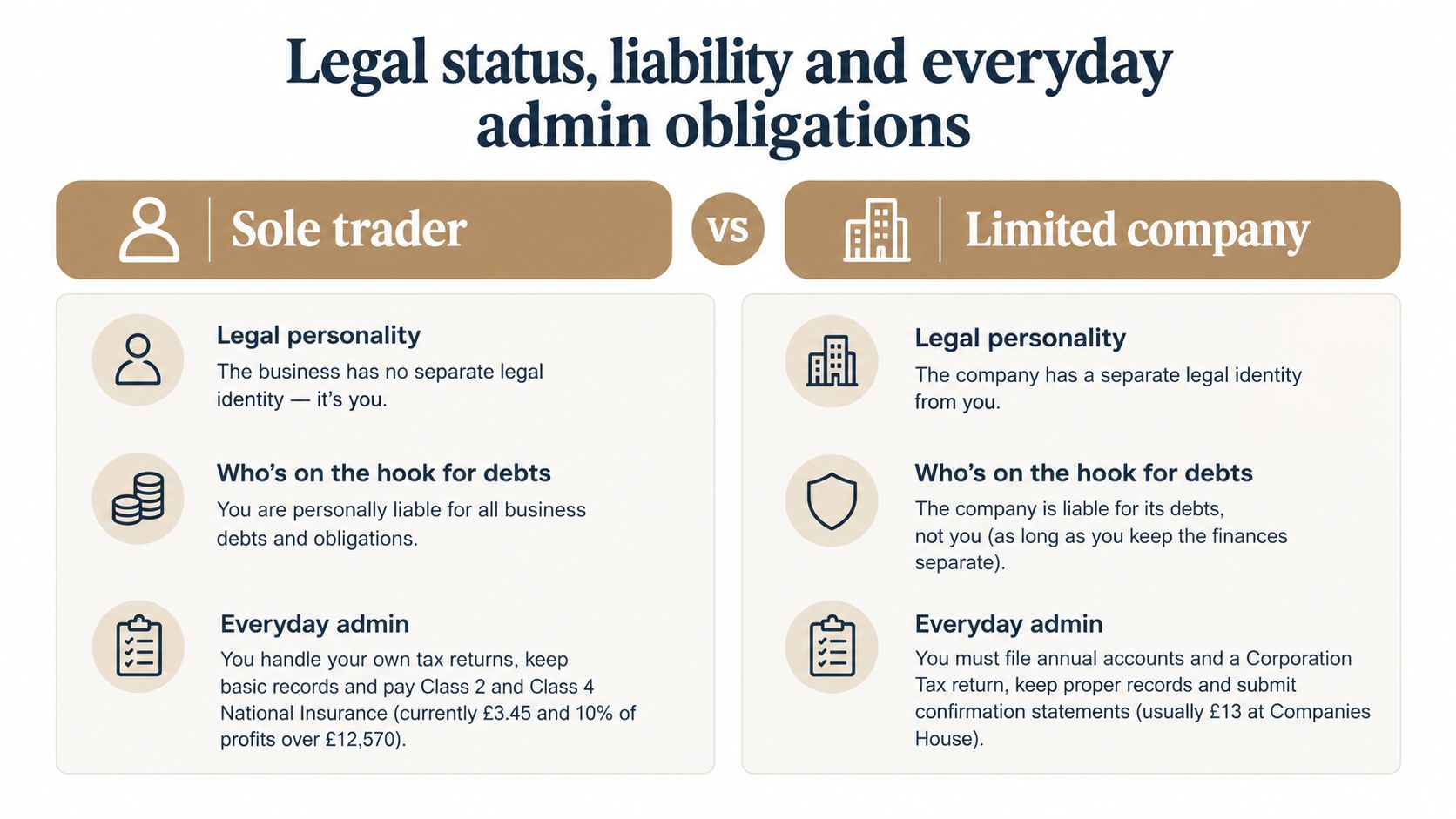
A sole trader and the business are legally the same person. That means the proprietor is personally responsible for business debts and contractual liabilities. If the business cannot meet an obligation, the owner doesn't have a separate corporate entity standing between the debt and personal finances.
A limited company has its own legal personality. Its owners normally risk the value of their investment rather than all personal assets, as explained in the guidance on limited company formation. That protection is valuable, but it isn't unlimited. Personal guarantees, wrongful or fraudulent trading, certain director misconduct and unpaid obligations can still create personal exposure.
The registration routes are different
A sole trader generally registers for Self Assessment when trading income exceeds £1,000 in a tax year, and reports taxable profit through the personal tax system. The owner keeps business records and calculates profit after allowable expenses.
A limited company must be registered with Companies House. The company needs its own accounting records, statutory accounts and Corporation Tax processes. The director remains responsible even if an accountant or other professional prepares the filings.
Every company, including a dormant company, must file a confirmation statement at least once every 12 months. Current GOV.UK guidance sets the online fee at £50 and the paper fee at £110. Failure to file can lead to a fine of up to £5,000 and possible removal from the register, according to Companies House confirmation statement guidance.
The admin burden follows the legal form
The sole trader route generally involves:
- Business records: Keep income and expense records that support the Self Assessment return.
- Personal reporting: Include business profit in the proprietor's tax return.
- Direct ownership: Business money belongs directly to the proprietor, subject to tax and business commitments.
The limited-company route adds:
- Statutory accounts: Prepare and file accounts, even where the company is dormant.
- Company tax: Submit a Company Tax Return and account for Corporation Tax.
- Director governance: Keep company and accounting records, report changes and maintain accurate Companies House information.
- Money separation: Treat company funds as company money, with withdrawals handled through salary, dividends or other permitted routes.
The additional work isn't a penalty. It is the operating cost of having a separate legal entity. Founders who want a structured process for company accounts can review working papers for limited company accounts, while still recognising that directors remain legally responsible for timely and accurate filings.
Tax, National Insurance and how money actually leaves the business
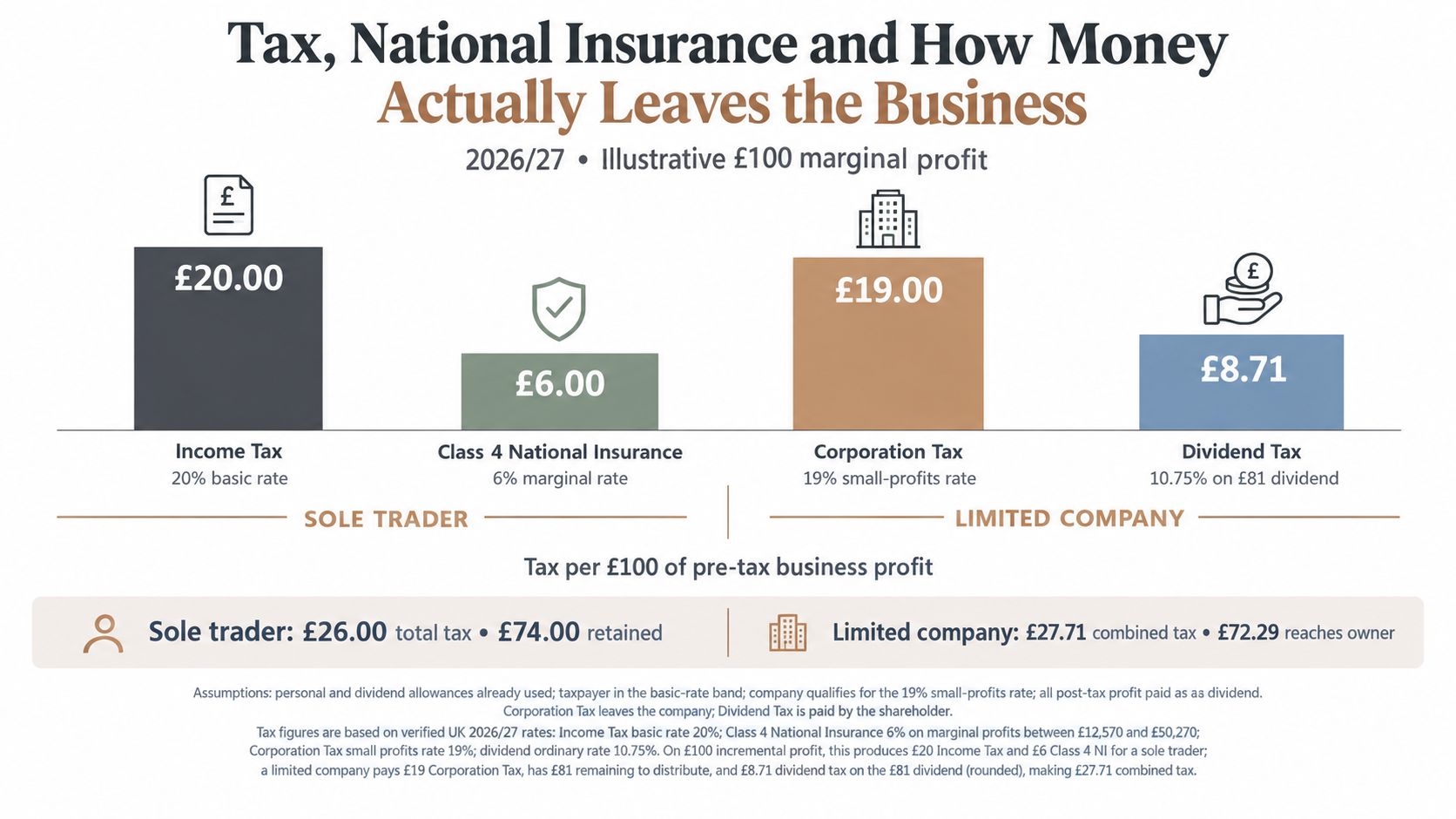
The tax comparison only becomes useful once the owner decides what the business will do with its profit. A sole trader is taxed personally on taxable business profit, whether that cash stays in the business bank account or is withdrawn. A company pays Corporation Tax first, then the owner faces personal tax according to the way money is extracted.
For the 2026/27 tax year, a self-employed sole trader with profits above £12,570 pays Class 4 National Insurance at 6% on profits between £12,570 and £50,270, and 2% on profits above £50,270, according to GOV.UK self-employed National Insurance rates. These rates apply to trading profits, not turnover.
A sole trader's calculation is comparatively direct:
- The business calculates taxable profit after eligible expenses.
- That profit is included in the owner's personal tax position.
- Income Tax and relevant National Insurance are assessed through the personal system.
- The owner can use the remaining cash personally, but the tax charge doesn't wait for a withdrawal.
A company has more moving parts. The company pays Corporation Tax on taxable profits. The government's cited rates are 19% on smaller profits up to £50,000 and 25% on profits above £250,000, with marginal-relief rules between those thresholds, as explained in HMRC's Corporation Tax guidance.
Extraction strategy matters more than the headline rate
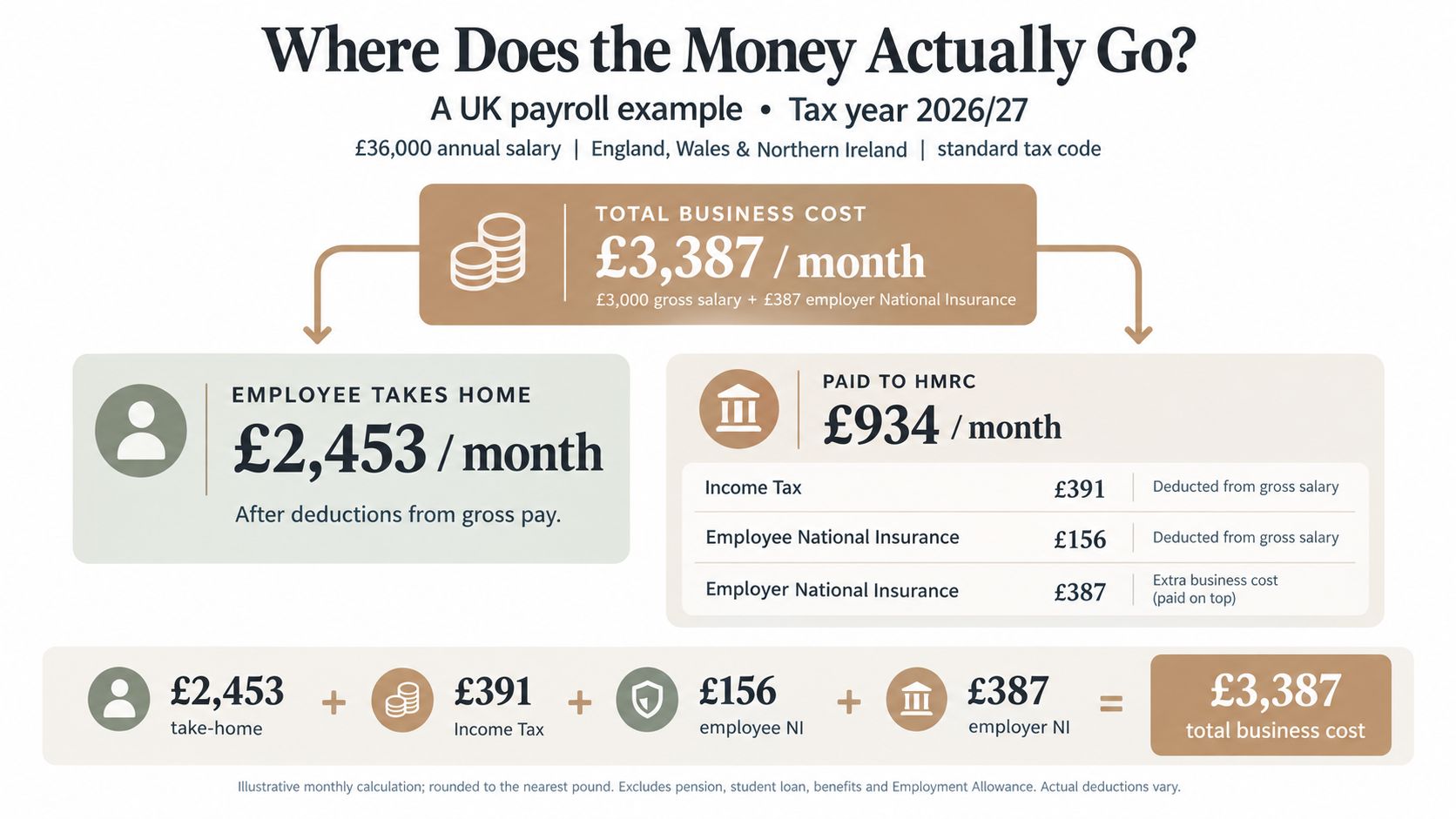
A director may combine a salary, dividends and retained profit. Salary interacts with payroll and employer costs. Dividends aren't deductible business expenses and can only be paid from available distributable profits. The shareholder may also owe Dividend Income Tax above the applicable allowance.
That creates a strategic difference. A sole trader usually needs to consider the full taxable profit in the current personal tax position. A company can retain some profit for working capital or growth, although the money remains company money and cannot be treated as personal cash without the correct extraction method.
The strongest comparison models:
- Salary: Amount paid through payroll and its National Insurance consequences.
- Dividends: Payments made from distributable post-tax profit.
- Retained cash: Profit left inside the company for stock, staff, equipment or resilience.
- Personal position: Other income, pension contributions, benefits and marginal tax bands.
- Compliance cost: Accounting, payroll, filing and governance work.
A founder considering allowable expenses should also review sole trader expenses explained. The decision should be based on the owner's actual extraction needs, not a single comparison table.
Worked scenarios showing when incorporation pays off
Worked scenarios are useful as mental models, not promises. The figures below are illustrative planning examples based on the business stages described, not tax calculations or guaranteed outcomes. A real comparison must account for expenses, personal income, payroll, pensions, benefits, compliance costs and the applicable tax treatment.
A freelancer with around £35,000 of profit
A solo freelancer with around £35,000 of profit, modest commercial risk and no immediate staffing plan will often find that sole trader status is the stronger starting point.
The owner may need most of the available cash personally. A company could introduce salary and dividends, but it would also create statutory accounts, director responsibilities, Company Tax Return work and Companies House administration. If the business has simple contracts and limited borrowing, the legal protection may not justify the extra operating burden at this stage.
The recommendation is clear: stay a sole trader while the work remains low-risk, owner-operated and straightforward, then review the structure when contracts, profits or staffing plans change.
A contractor with around £75,000 of profit
A contractor with around £75,000 of profit faces a different calculation, particularly if personal spending doesn't consume all available cash.
A limited company may allow the owner to set a planned salary, pay dividends from distributable profit and retain some money for working capital. The benefit isn't automatic. If every pound is extracted immediately, the company's Corporation Tax, personal tax, National Insurance, payroll and professional costs may reduce or remove the expected advantage.
The recommendation is to run both structures against the contractor's actual cash needs. Incorporation deserves serious consideration where profit is stable, risk is meaningful and cash can remain in the business.
A founder with around £150,000 of profit and two planned employees
A founder expecting around £150,000 of profit and planning to employ two people is no longer making a purely personal drawings decision.
The business will need to handle PAYE, workplace pension responsibilities, employment contracts, payroll administration and the risk attached to managing staff. A company may offer a cleaner framework for those obligations and for retaining cash, even where the immediate tax saving is modest. The founder still needs to budget for employer costs, professional support and the possibility that hiring changes cash flow before it improves capacity.
The recommendation is stronger here: incorporation usually deserves priority before the first employees start, because the business is becoming an organisation rather than just a person selling time.
| Founder profile | Sole trader tends to suit when | Limited company tends to suit when |
|---|---|---|
| Freelancer | Work is low-risk, irregular or mainly delivered personally | Contracts, claims or commercial exposure are increasing |
| Contractor | Nearly all profit is needed personally and administration must stay light | Profit is stable and some cash can remain in the business |
| First employer | Staffing is only a distant possibility | Employees, payroll and workplace obligations are imminent |
| Growth business | The venture is still being tested | The founder is building a team, retaining profit or entering larger contracts |
What limited liability actually protects, and what it does not
Limited liability protects the owner from treating every company debt as a personal debt. It does not guarantee that personal assets are untouchable.
A private limited company normally stands as a separate legal entity, so shareholders are generally responsible for business debts only up to the value of their financial investment. A sole trader has no equivalent separation. The proprietor remains personally responsible for business debts and contractual liabilities.
Personal exposure can return through the back door
Lenders, landlords and finance providers may ask a director to give a personal guarantee. If the company defaults on that obligation, the guarantee can put the individual at risk even though the underlying borrower is a company. A plain-English guide to how personal guarantees work can help a founder understand the commitment before signing.
Directors can also face personal consequences for wrongful or fraudulent trading, certain misconduct, guarantees and unpaid obligations. When a company is financially distressed, directors must take their duties seriously and avoid treating company money as personal money.
Limited liability is a legal boundary, not a substitute for insurance, sensible contracts or cash reserves.
The insolvency context makes this especially important. In England and Wales, there were 22,455 business insolvencies in 2025, equal to 116 insolvencies per 10,000 businesses, compared with 88 per 10,000 in 2019, according to the business insolvency demography commentary. The UK also recorded 23,938 registered company insolvencies in 2025, including 18,525 creditors’ voluntary liquidations, in the same source.
Company status can separate the owner from ordinary company liabilities, but it cannot stop insolvency. A sole trader and a company also face different insolvency routes, so the structure should be chosen before trouble appears, not as a last-minute shield.
Your decision checklist, key lesson takeaways and next steps
A founder can make the decision more clearly by testing the structure against the next business stage.
Use this decision worksheet
- Freelancer: If the work is low-risk, the income is uneven and nearly all profit is needed personally, start by testing whether sole trader simplicity outweighs incorporation.
- Contractor: If contracts are becoming larger or a meaningful amount of cash can stay in the business, compare a sole trader position with a salary, dividend and retained-profit model.
- First employer: If staff are imminent, assess payroll, workplace pension duties, employment contracts and commercial risk before the first hire.
- Growth business: If the founder is building an organisation, signing substantial contracts or borrowing, treat legal separation and governance as decision factors, not afterthoughts.
The key lesson is that profit alone doesn’t decide the structure. Risk, employment, cash retention, administration and the founder’s personal tax position all matter. Sole trader status remains common across the wider UK business population, while company structures are particularly prevalent among VAT and PAYE-registered businesses. Incorporation is also available to solo founders, with ONS data showing that 44% of UK companies were effectively single-employee limited companies.
Takeaways worth acting on
- Simplicity: Sole trader status is usually easier to administer for a low-risk owner-operated venture.
- Separation: A company creates a distinct legal entity, but guarantees and director conduct can still create personal exposure.
- Extraction: The company tax comparison only works when salary, dividends, retained profit and personal circumstances are modelled together.
- Growth: Employing people and building an organisation can justify incorporation even where immediate tax savings are uncertain.
- Review point: A founder can change structure later, but should plan the transfer of contracts, assets, records and banking arrangements.
Before committing, gather the previous year’s figures, estimate the cash needed personally, list planned salary and dividend payments, and identify any money intended for business growth. Confirm the relevant registration and filing requirements with HMRC and Companies House. A financial forecasting toolkit can help organise the assumptions before professional accounting advice is obtained.
The choice remains personal to the business. A calculation should be reviewed where the founder has other income, pension contributions, benefits, employees, guarantees, substantial borrowing or a plan to retain significant profit.
Accountant She Ltd provides online accountancy training, courses, templates and practical resources for accountants, practice owners and business founders.