
A completed AML policy isn't proof that a practice's controls work. During the 2022/23 reporting period, accountancy supervisors identified inadequate documented procedures, client risk assessments and firm-wide risk assessments among the most common breaches, according to ICAEW's summary of supervisory findings.
For UK practice owners and compliance leads, anti money laundering for accountants needs to function as a control framework: named owners, risk-based checks, clear review triggers and evidence that decisions were followed through. Scaling safely means making those controls transferable, so compliance doesn't depend on the owner remembering every client's history.
Table of Contents
- How anti money laundering for accountants works as a control framework
- Registration, approval and enforcement under the UK rules
- Building a firm-wide risk assessment that holds up
- Client due diligence and onboarding evidence
- Choosing between standard, enhanced and simplified due diligence
- Monitoring, training and suspicious activity reporting
- Scaling your AML controls as the practice grows
How anti money laundering for accountants works as a control framework
AML compliance is a documented, closed-loop process, not an onboarding questionnaire followed by an annual policy signature. The practical test is whether someone outside the client team can reconstruct the practice's decisions from its records.
A growing practice needs a consistent route from identifying risk to addressing it, then checking that the response still works. That route should cover every regulated service and delivery channel, including work passed between bookkeeping, accounts, tax, payroll and advisory teams.
Build the framework around decisions
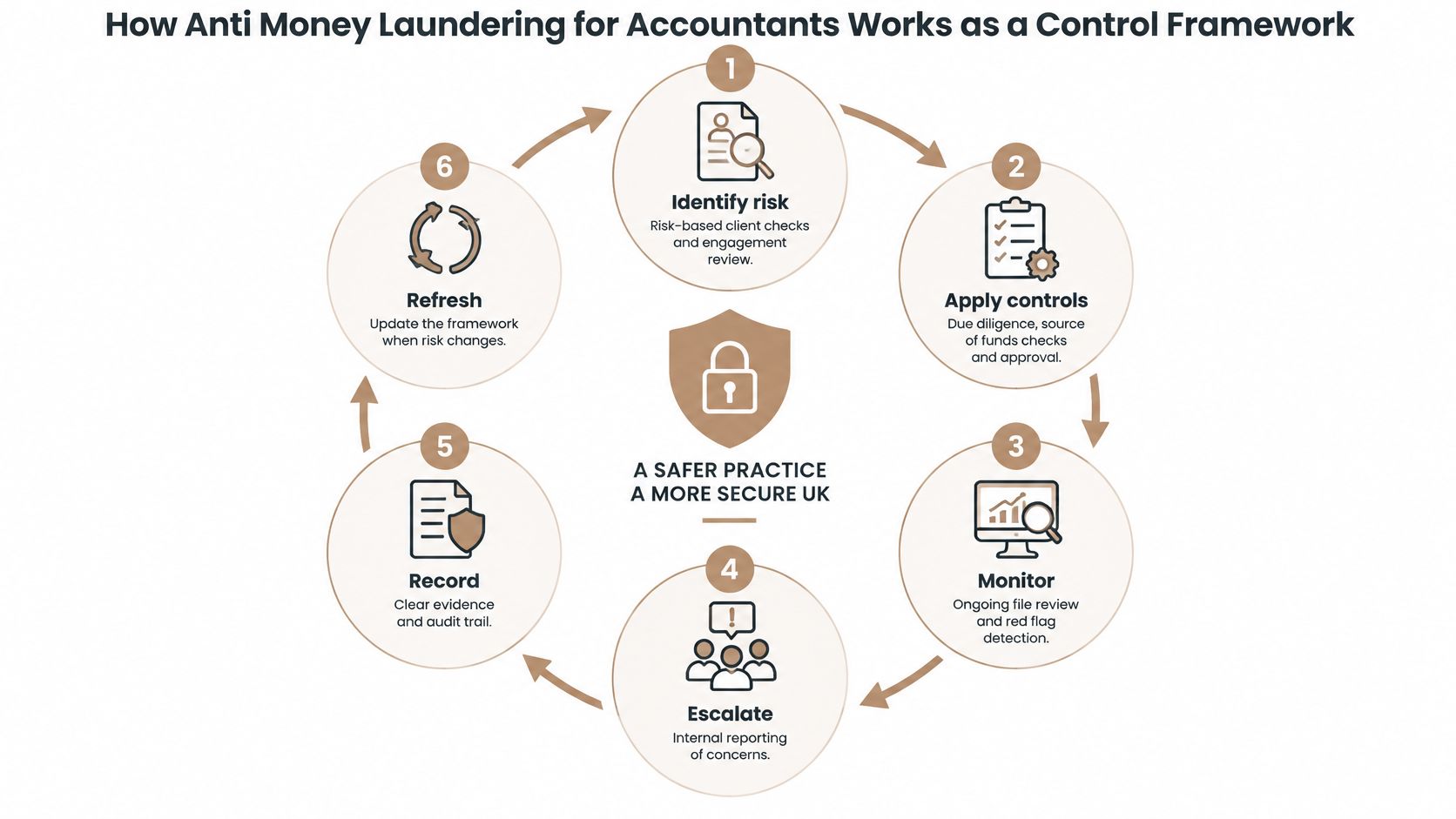
The methodology in HMRC's guidance on risks common to accountancy service providers translates into the following operating sequence:
- Map the work: Identify regulated services and how clients access them, including remote relationships and intermediary introductions.
- Assess practice-wide exposure: Consider money laundering, terrorist financing and proliferation-financing risks.
- Translate risk into controls: Decide which policies, procedures and approvals address each identified exposure.
- Assess prospective clients: Assign and explain a client risk rating before the relationship begins.
- Establish identity and control: Identify and verify the customer, beneficial owners and relevant controllers.
- Understand expected activity: Record enough about the business to recognise activity that doesn't fit.
- Apply additional scrutiny: Use enhanced due diligence where the risk factors justify it.
- Monitor changes: Reconsider the relationship when circumstances or activity change.
- Keep the reasoning: Retain evidence of checks, reviews, approvals and decisions.
The diagram provides a compact view of the recurring control cycle.
Give each control an owner and an output
A useful control register records the responsible person, the trigger, the action and the evidence produced. “Review client risk” is too vague. “The client manager reviews ownership changes and records the revised assessment before acceptance of additional work” is actionable.
For broader reading, Loopfour's compliance tags provide a supplementary discovery route, rather than an authority on UK AML obligations. The compliance resource page can sit alongside a practice's implementation materials, without replacing its own documented procedures.
Practical rule: A control needs a responsible person, a trigger and a retrievable record. Without those, the practice has an intention rather than a dependable process.
This is general educational guidance. Uncertain supervision arrangements, complex ownership structures and suspicious-activity decisions require advice appropriate to the practice's circumstances.
Registration, approval and enforcement under the UK rules
Registration comes before regulated work. UK accountancy service providers must have an appropriate AML supervisor; where supervision isn't provided by the Financial Conduct Authority or an approved professional body, HMRC registration is generally required. Operating without the required registration is an offence, as explained in HMRC's accountancy service provider registration guidance.
The underlying framework is the Money Laundering, Terrorist Financing and Transfer of Funds (Information on the Payer) Regulations 2017. HMRC supervised 36,782 businesses in 2024/25, comprising 28,837 firms and 7,945 sole practitioners; the same annual report records 12,888 supervision applications, 933 rejections and approximately 9% of the supervised population categorised as high-risk (HM Treasury's AML supervision report).
Those figures concern the populations described in the report, not accountants alone. Their practical significance is that supervision and suitability checks are active controls, not administrative formalities.
Separate firm registration from individual approval
Registration of the business doesn't settle every approval requirement. Beneficial owners, officers and managers of relevant firms, including external accountants and tax advisers, also fall within the approval provisions.
Acting as a manager or officer, or knowingly acting as a beneficial owner, without required approval is a criminal offence. Under regulation 26, the potential penalty on summary conviction in England and Wales includes imprisonment for up to three months, a fine or both; conviction on indictment can include imprisonment for up to two years, a fine or both.
A practical gateway file should therefore distinguish:
- Business supervision: The supervisor, registration evidence and regulated activities covered.
- Relevant individuals: The owners, officers and managers whose approval needs consideration.
- Change control: Who checks the position when ownership, management or the practice structure changes.
Treat enforcement as an operational risk
HMRC's options include financial penalties, management prohibitions, published censuring statements, criminal investigation, and suspension or cancellation of registration. A suspension can prevent relevant regulated trading, while an unregistered business may face registration-related penalties alongside penalties for separate breaches such as inadequate due diligence (HMRC's civil enforcement measures).
For practice management, the sensible response is a documented pre-change check. A new service, acquisition or management appointment shouldn't reach implementation before someone has considered its supervision and approval implications.
Building a firm-wide risk assessment that holds up
A firm-wide risk assessment identifies exposure arising from the practice's business model. An effectiveness review asks whether the resulting controls work. Submitting the latter in place of the former leaves a different question unanswered.
The distinction matters in supervision. An ICAEW thematic review found that 88% of firms had completed a firm-wide risk assessment, while 6% submitted an AML compliance review instead; ICAEW's 1,608 monitoring reviews in 2025/26 classified 14.8% as compliant, 69.7% as generally compliant and 15.5% as non-compliant (accountancy-sector AML guidance and supervisory material).
Start with the practice's actual business model
A usable assessment needs more than a list of generic risks. Its structure should connect the practice's work to the controls staff apply in their day-to-day work.
| Assessment area | Question to address | Operational consequence |
|---|---|---|
| Services | What work creates exposure, and why? | Service-specific acceptance checks |
| Clients | Which client characteristics affect risk? | Risk-rating criteria |
| Geography | Where do clients, owners and activities operate? | Additional enquiries where justified |
| Delivery channels | How are relationships established and managed? | Verification and communication controls |
| Third parties | Which intermediaries or outsourced providers are involved? | Network due diligence |
| Practice structure | Where could responsibility become unclear? | Named owners and handover procedures |
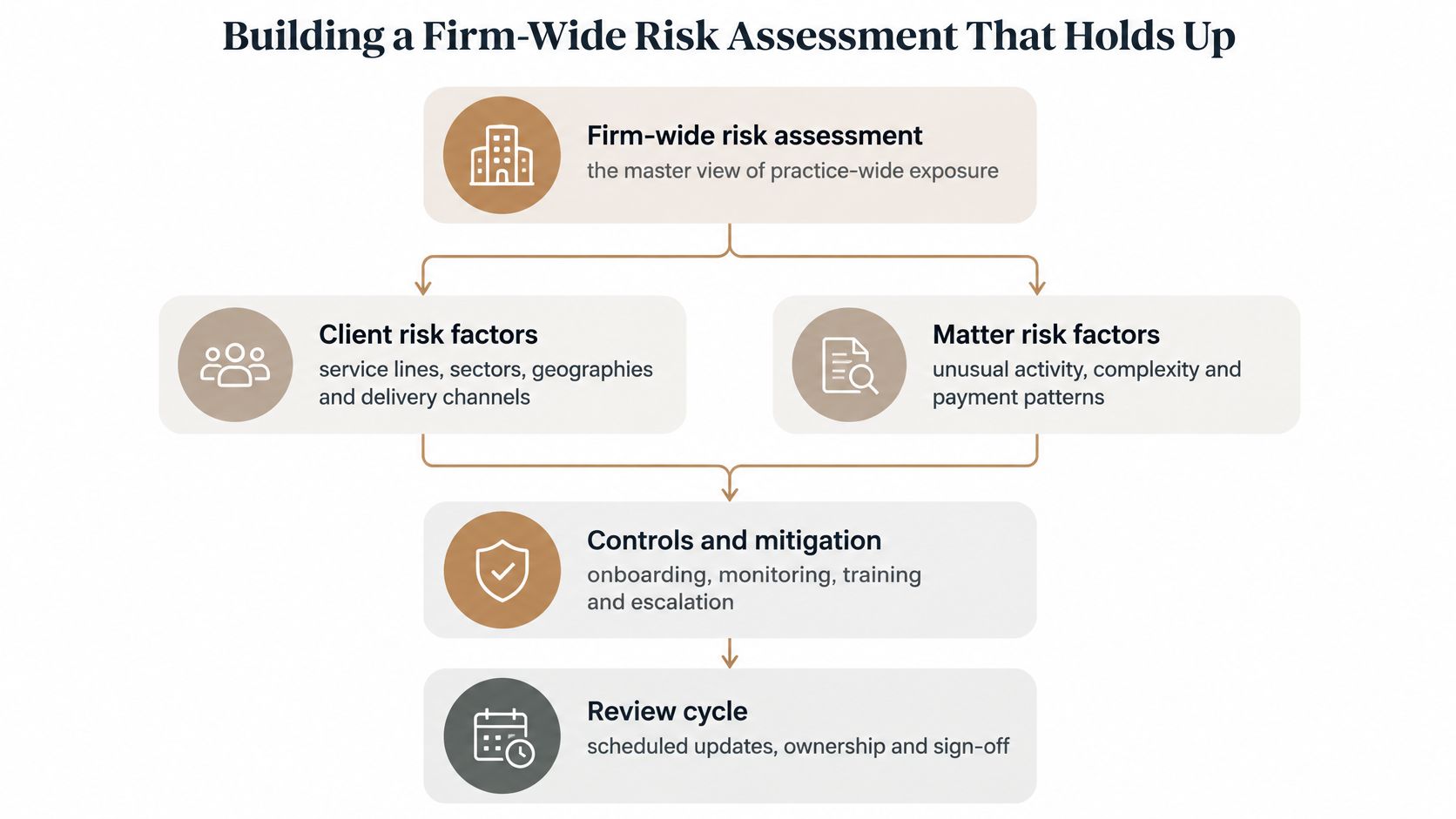
The hierarchy below shows how the practice-wide assessment connects to client and matter-level decisions.
Record the link between exposure and mitigation
Adding overseas company formation work should prompt questions before the service launches. The assessment needs to address the proposed jurisdictions, ownership complexity, delivery arrangements and ability to understand the commercial purpose.
That isn't evidence that every overseas connection presents the same risk. The assessment should explain the particular exposure, the additional control and the person authorised to accept any remaining risk.
A reviewer should be able to follow the route from the practice's business model to its risk assessment, then from that assessment to the controls applied on client files.
A named compliance lead should maintain the assessment, with leadership responsible for approving material changes. The practice should set a scheduled review point and require reconsideration when services, client mix, geography or delivery arrangements change.
Version history matters. Keeping the previous assessment, the reason for amendment and the approval record makes it possible to show how the framework developed as the practice grew.
Client due diligence and onboarding evidence
An identity check doesn't establish everything a practice needs to know about a client. Customer due diligence (CDD) includes identifying the customer and, where relevant, beneficial owners, with reasonable measures to verify beneficial-owner identities so the firm is satisfied it knows who they are (HMRC's beneficial ownership guidance).
A company name or Companies House number alone may therefore leave the ownership question unresolved. The file needs to explain who ultimately owns or controls the customer and how the practice reached that conclusion.
Build an acceptance file rather than a document collection
A useful onboarding file should connect the evidence to the acceptance decision.
- Customer identification: Record the legal customer and the person instructing the practice.
- Ownership and control: Retain an understandable ownership structure and supporting verification evidence.
- Business understanding: Explain what the business does, how it trades and what activity the practice expects.
- Risk rationale: Record the factors considered, not merely the final rating.
- Acceptance decision: Identify who approved the relationship and any conditions or unresolved matters.
- Monitoring handover: Set the review arrangements and make the baseline available to the delivery team.
The prospective client checklist for accountants and bookkeepers provides a relevant checkpoint within that workflow. A checklist should prompt enquiries, however, rather than substitute for recording the answers.
Make ownership complexity visible
For a limited company with an overseas corporate shareholder, the file should show how the practice traced ownership and control through the structure. If the evidence doesn't support a clear conclusion, the file shouldn't present the enquiry as complete.
The acceptance record should distinguish verified information, explanations supplied by the prospective client and outstanding questions. That separation prevents a plausible account of the structure from being mistaken for verified evidence.
For a cross-sector documentation comparison, the Closer Innovation Labs broker KYC guide offers a supplementary reference point, not a source of UK accountancy AML requirements.
In a growing team, the person collecting evidence and the person approving acceptance may differ. A shared file structure, clear status labels and a recorded handover help prevent work starting because someone assumes another colleague has completed the checks.
The acceptance decision should be reconstructable without the original relationship owner explaining it.
Choosing between standard, enhanced and simplified due diligence
Due diligence should follow the assessed risk and applicable requirements, not the fee, the client's familiarity or pressure to start work. A long-standing introduction isn't a substitute for a documented assessment.
The useful distinction is between the reason for selecting a level and the evidence needed to support that selection. A label without a rationale doesn't explain why the practice considered its enquiries sufficient.
Due diligence levels and when they apply
| Due diligence level | When it applies | Evidence required | How the decision is recorded |
|---|---|---|---|
| Standard | The assessment supports the normal CDD approach, subject to applicable requirements | Customer and beneficial-owner evidence, business understanding and expected activity | Relevant risk factors, conclusions and acceptance approval |
| Enhanced | Identified risk factors or applicable requirements call for additional scrutiny | Additional enquiries, corroboration and approvals appropriate to the particular risk | Why additional measures were needed and how concerns were addressed |
| Simplified | Only where the applicable rules permit it and the lower-risk assessment supports its use | Evidence supporting eligibility and the proportionate measures applied | Why simplified treatment is permitted and justified |
The simplified route shouldn't become shorthand for skipping difficult questions. Where eligibility is uncertain, the practice should seek appropriate guidance before reducing its enquiries.
Refresh on events as well as dates
A scheduled review provides a backstop, but staff also need event-based triggers. The control should require reassessment after changes in ownership, geography, services or transaction patterns, rather than waiting for the next diary entry.
The client manager should record the trigger and route the matter to the appropriate reviewer. Central visibility of overdue reviews helps the compliance lead distinguish an isolated delay from a process that isn't being followed.
Check the professional network
Before entering a relationship with a business, customer or intermediary carrying out regulated activity, the practice should take appropriate steps to verify that party's AML supervision. Where supervision cannot be confirmed, the relationship shouldn't proceed; this deserves attention given that accountancy services were assessed as high risk in the UK's 2025 National Risk Assessment (HMRC's supervision verification guidance).
Outsourced bookkeepers, payroll providers, tax agents, company-formation firms, introducers and overseas advisers need consideration according to their activities and circumstances. A recommended record includes:
- Verification evidence: The entity checked, supervisory details, enquiry date and result.
- Review ownership: A named person responsible for rechecking when circumstances change.
- Unresolved status: A clear hold and escalation route rather than an informal exception.
- Communication control: A factual refusal or exit record, with specialist advice where suspicious-activity or tipping-off concerns arise.
Monitoring, training and suspicious activity reporting
Post-onboarding assurance needs evidence that staff reviewed the relationship, identified exceptions and completed corrective action. Possessing a current policy doesn't demonstrate any of those things.
The Institute of Financial Accountants conducted 191 monitoring reviews in 2025/26, with 33% of reviewed firms required to provide evidence that identified non-compliant issues had been remedied, compared with 31% previously. Its report also highlights the UK guidance update published in January 2026, including risks common to accountancy service providers and obligations concerning CDD, records and suspicious-activity reporting (IFA supervision and monitoring report).
Use a quarterly assurance cycle
A quarterly cycle is a practical management recommendation, not a universal statutory timetable. The scope should reflect the practice's risk and complexity.
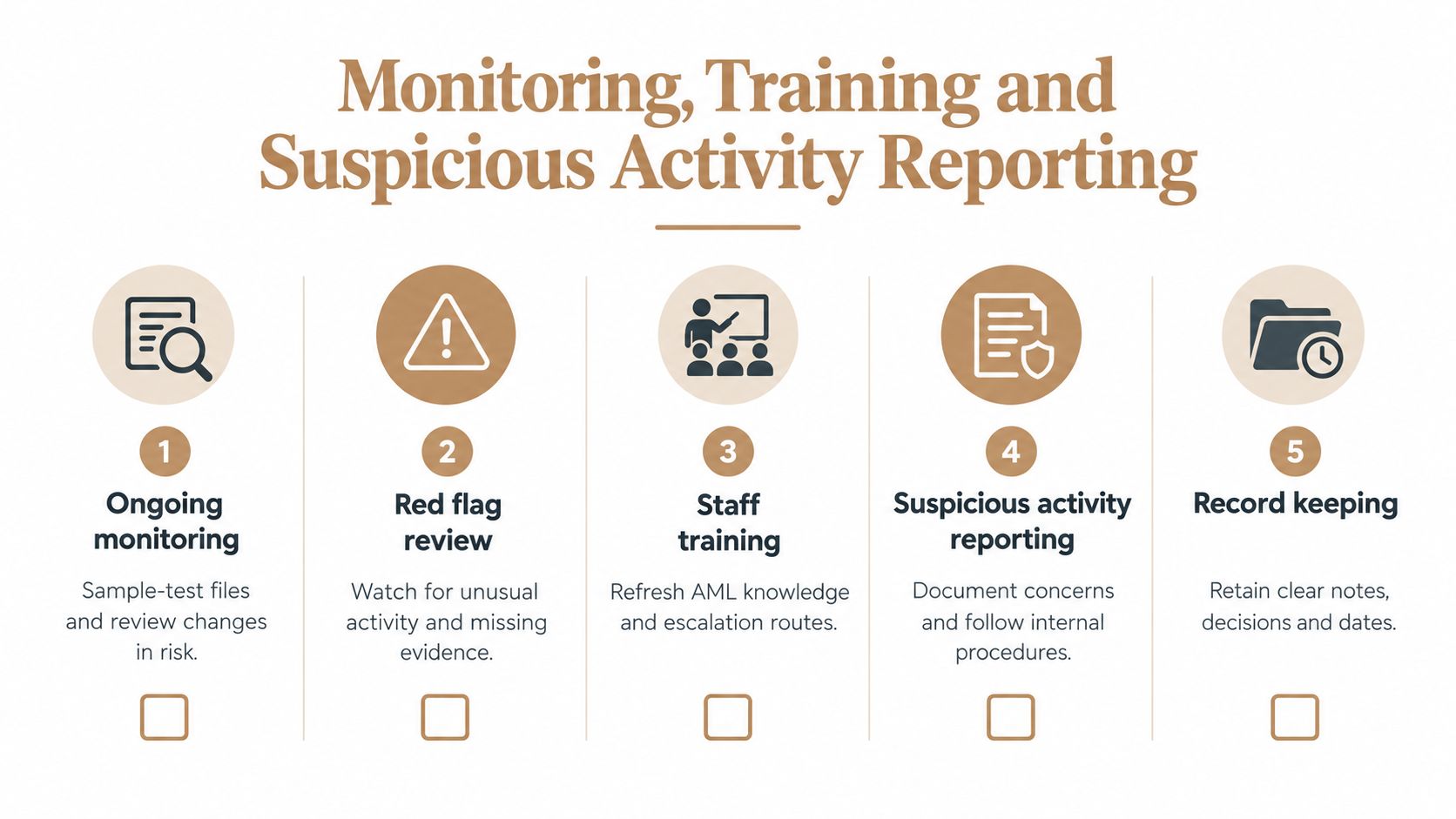
- Sample client files: Examine the quality of acceptance decisions, monitoring records and handovers, including exceptions.
- Maintain an exception log: State the issue, its significance, the responsible person and the target completion date.
- Test training understanding: Retain attendance records alongside exercises or discussion notes showing that staff understood the procedure.
- Check remediation: Record evidence of the correction and who confirmed that it addressed the weakness.
- Report recurring problems: Escalate patterns to leadership so the practice changes the underlying process.
The checklist below summarises the evidence-producing activities.
Give concerns a controlled reporting route
Staff need to know who receives an internal concern and what information to provide. Training should distinguish an unusual item needing explanation from a concern that requires prompt escalation; a checklist can't settle every judgement.
A recommended internal report records the relevant facts, dates, documents and reason for concern. The designated decision-maker should retain the assessment, enquiries and rationale for the action taken, including any external reporting decision.
Escalation discipline: Staff should report concerns through the designated route, not investigate independently or discuss a possible report with the client.
Suspicious activity reporting and tipping-off questions are legally sensitive. The procedure should direct staff to the responsible compliance person and provide access to specialist advice where necessary.
Sensitive reporting records need controlled access. General client-file notes, training records, policy amendments and quality-review findings should also be retrievable, but access arrangements shouldn't expose confidential escalation material unnecessarily.
Scaling your AML controls as the practice grows
The main scaling risk is a gap between responsibility and visibility. A sole practitioner may know every client's background; a delivery team needs that knowledge translated into records, permissions and handovers.
Good accountancy practice management makes compliant work the normal workflow. Extra forms won't solve unclear ownership, and central oversight won't help if the client team can't recognise when to escalate.
Match the controls to the practice stage
| Practice stage | Likely pressure point | Control adjustment | Evidence to retain |
|---|---|---|---|
| Sole practitioner | Decisions remain in the owner's memory | Document acceptance and review reasoning as work happens | Dated assessments, decisions and review records |
| First employee | Informal delegation creates assumptions | Define tasks, approval boundaries and escalation routes | Training evidence and supervised file reviews |
| Multi-person firm | Different managers apply different standards | Allocate control owners and calibrate review decisions | Responsibility register and quality-review findings |
| Multiple offices or service lines | Local procedures drift | Maintain central standards with documented variations | Cross-team reviews, exception reporting and corrective-action sign-offs |
The trade-off is between central consistency and local judgement. A rigid form can obscure unusual circumstances; unrestricted discretion makes quality difficult to supervise. The stronger arrangement is a common minimum standard with a documented route for justified exceptions.
In a delivery team, the client manager, compliance lead and engagement partner each need a visible route to escalate an exception. The photograph below shows the working relationship that escalation depends on; the control register records who owns that route.

Use resources to implement rather than accumulate
An on-demand training library and structured practice systems resources can support implementation. Each control still needs a named owner, a refresh trigger and evidence that the procedure was followed.
For anti money laundering for accountants, the next improvement should address the weakest operational control. That might be an assessment disconnected from current services, unclear responsibility for refreshes or corrective actions that nobody verifies.
The practice should select that weakness, assign an owner and define what satisfactory evidence will look like. Completing and testing that improvement is more useful than adding another unused template.
Accountant She Ltd offers online training, templates and practical resources for accountants, bookkeepers and practice owners developing their compliance and management systems.