Revenue vs Profit vs Cash Flow: The Three Numbers Every Business Owner Must Know
Table of Contents
- Revenue vs profit vs cash flow, in one simple explanation
- What revenue means, and what it does not
- The difference between revenue and profit
- Profit vs cash flow, why profitable businesses still feel broke
- Why bigger revenue does not always mean a better business
- How tax fits in for UK business owners
- The monthly numbers checklist to review
- Key lesson takeaways
- Conclusion
Revenue vs profit vs cash flow, in one simple explanation
Think of it like this:
Revenue = all the money your business earns from what it sells, before costs.
Profit = what is left after you take business costs away from that revenue.
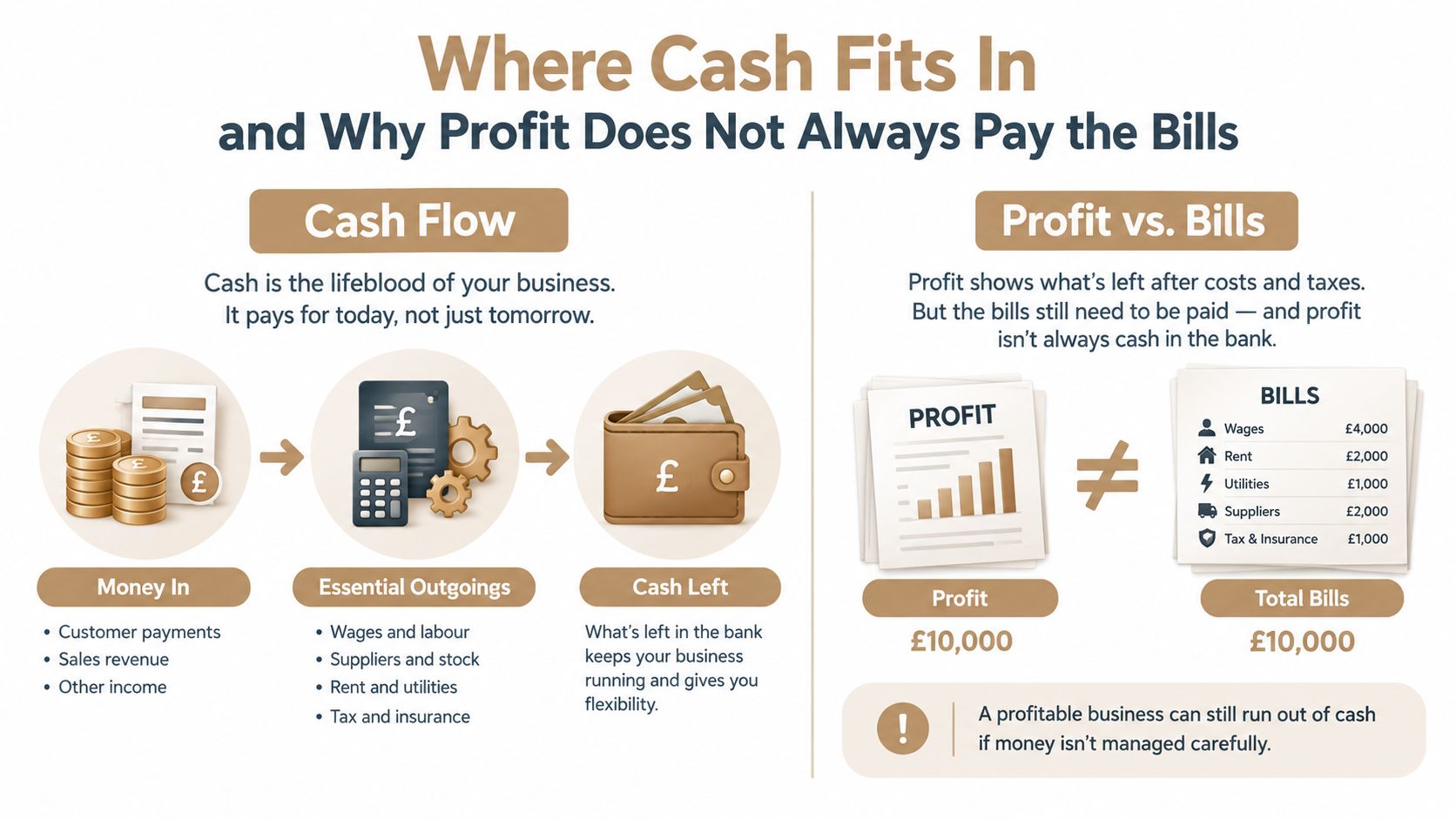
Cash flow = the movement of money in and out of your bank account, and therefore how much cash you actually have available.
Rachel puts the distinction like this:
“Revenue is vanity, profit is sanity, bank balance is reality.”
That line is memorable because it solves a very common business-owner problem. You can have a busy month, send lots of invoices and still feel anxious about money. That is not automatically a contradiction. It usually means revenue, profit and cash are being treated as if they are one number, when they are actually three different ones.
If you understand those three numbers separately, it becomes much easier to answer practical questions like:
understanding gross revenue before selling
Are my prices high enough?
Is this business actually leaving enough for me?
Why does my bank balance feel tight when sales looked good?
Can I afford to hire, invest or increase my own pay?
What revenue means, and what it does not
Revenue is the total income from the goods or services your business sells. You might also hear it called turnover.
In the lesson, Rachel defines it simply:
“Revenue is, very simply, all of the money that comes into your business from what you sell, and this is excluding any VAT.”
That makes revenue a top-line number. It tells you the scale of your sales activity. It does not tell you:
how expensive the work was to deliver
how much you get to keep
whether the customer has paid you yet
whether you can afford upcoming bills
Revenue is useful, but limited on its own. A high-revenue business can still be low-profit, or even loss-making, if costs are too high.
Rachel's warning in the lesson is especially practical:
“Don't look at someone's turnover because anyone can sell £5 notes for £4.”
That is the clearest way to understand why turnover alone is not a sign of a healthy business.
The difference between revenue and profit
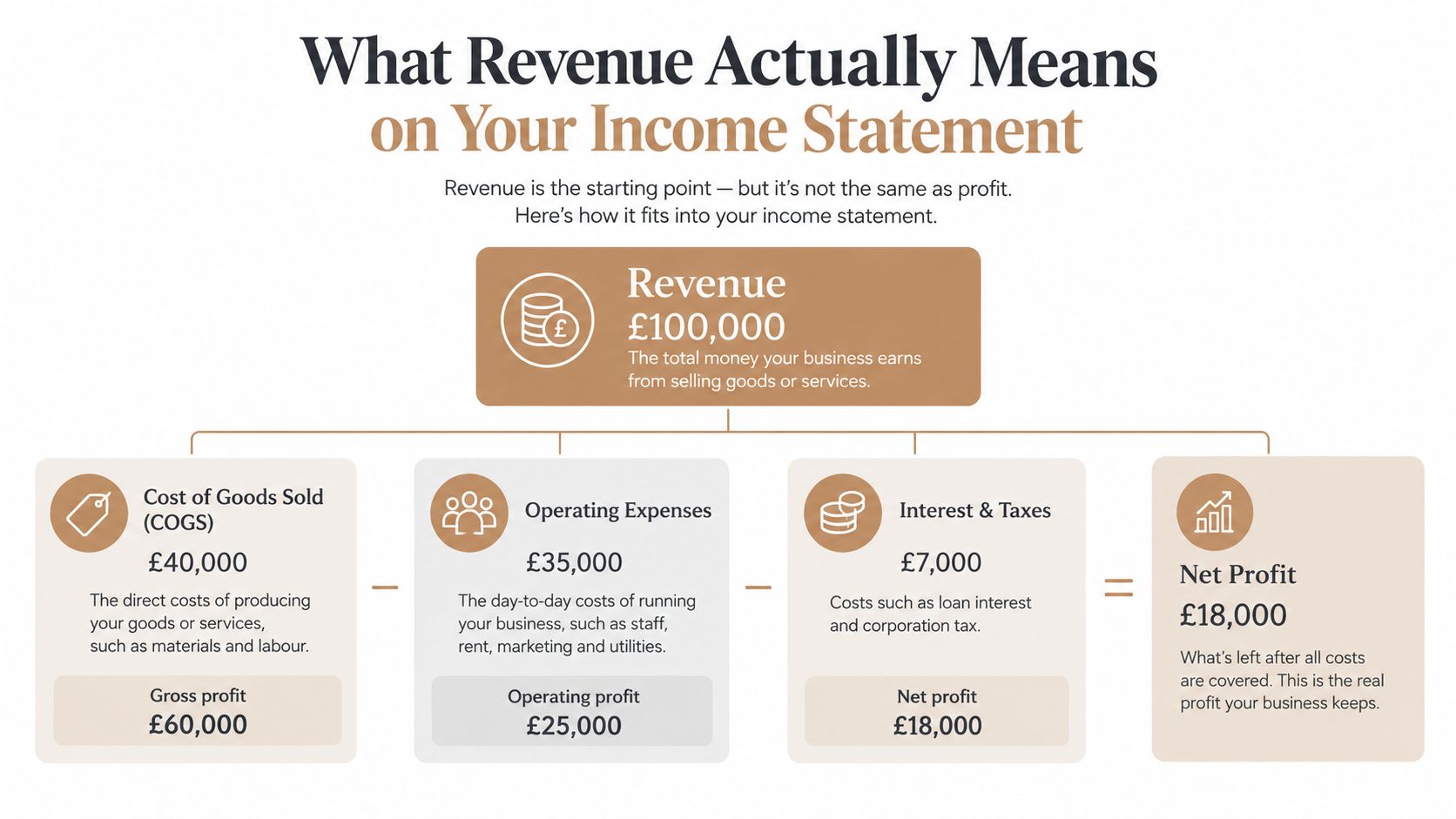
The difference between revenue and profit is simple:
Revenue is what came in from sales.
Profit is what remains after business costs have been deducted.
Those costs usually fall into two broad groups:
Direct costs
These are costs tied closely to delivering the work or product itself. Depending on the business, they might include:
materials
subcontractors
delivery staff wages
job-specific software or tools
Overheads
These are the costs of running the business whether you sell much that month or not, such as:
software subscriptions
rent
insurance
admin support
general marketing
Rachel explains the key point well:
The Profitability Playbook for Accountants and Bookkeepers
“Your profit is what is left over when you take your costs away from your revenue.”
Profit matters because it shows whether the business model works. If your pricing, service mix and costs still leave a meaningful surplus, the business is creating value. If not, more sales can just create more pressure.
A simple worked example
Suppose your business brings in £10,000 in one month.
That means:
- Revenue: £10,000
Now assume your total costs for that month are £6,000.
That means:
Costs: £6,000
Profit: £4,000
This is the worked example Rachel uses in the lesson:
The ONS estimates provide further detail on firm-level profitability differences
“If your revenue was £10,000 in 1 month and your costs to generate that £10,000 as a business were £6,000, then your profit is £4,000.”
That £4,000 tells you much more than revenue alone. It starts to answer the real business question: after doing the work and paying the costs, what did the business actually leave behind?
You can also think about this as a profit margin:
- Profit margin = £4,000 ÷ £10,000 = 40%
That kind of calculation helps you compare clients, offers or service lines more clearly than revenue alone.
Profit vs cash flow, why profitable businesses still feel broke
This is where most of the confusion shows up.
ONS discussion of UK business dynamism and productivity
A lot of business owners assume profit and cash are basically the same thing. In practice, they often are not.
Profit is an accounting result after costs.
Cash flow is about the timing of money moving in and out of the business.
Rachel says:
“Your cash is simply what is sitting in your bank account right now, today.”
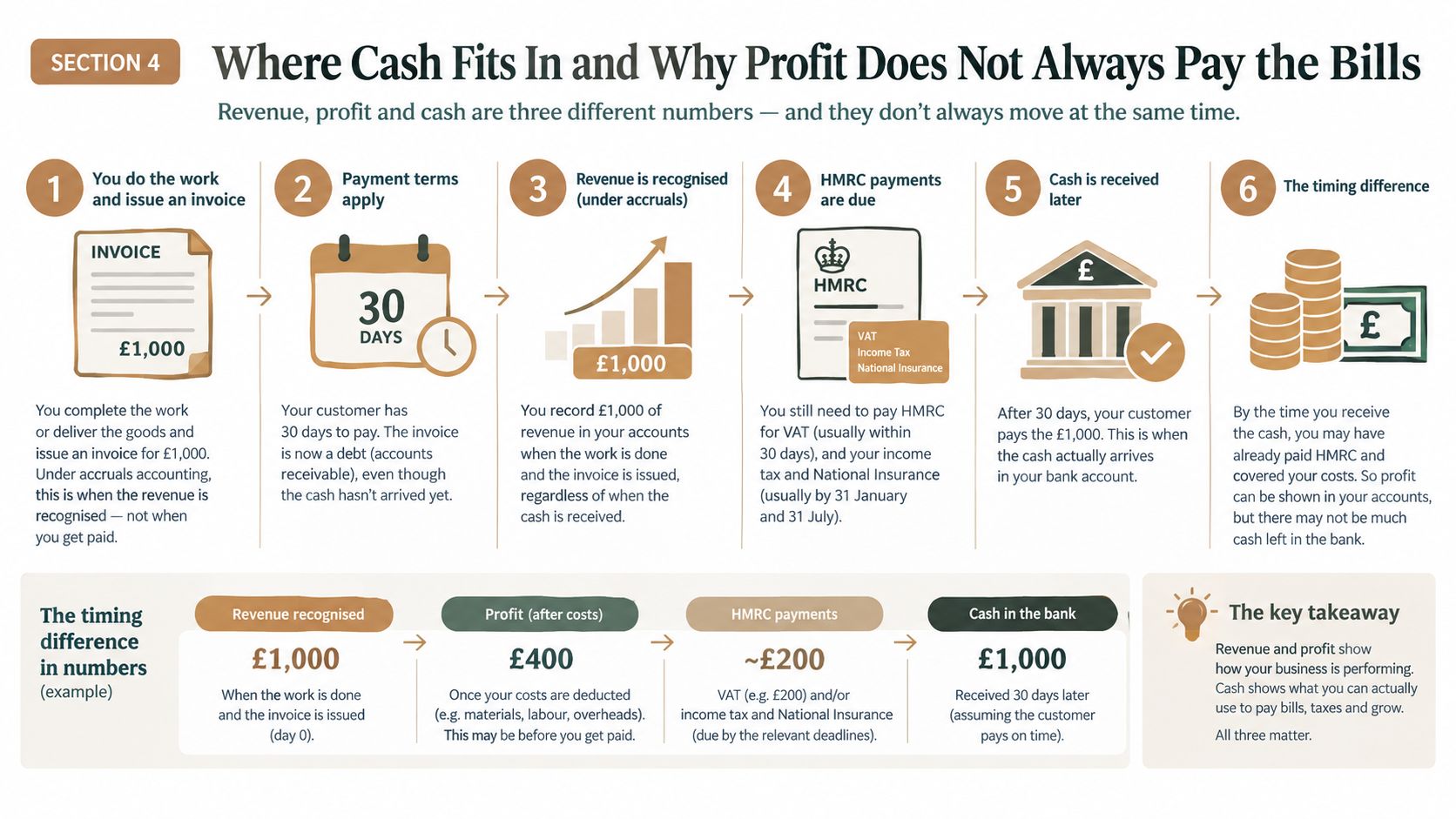
And the reason profit and cash part company is usually timing.
HMRC's accounts guidance explains the accruals basis and why accounting figures don't equal cash
For example:
You complete work for a client.
You send the invoice.
The sale appears in your accounts.
Your profit and loss can show the revenue and profit.
But the customer still has not paid.
So you may look profitable on paper while feeling tight in real life.
Rachel describes that gap like this:
“You can be genuinely profitable on paper and still look at your bank account and feel sick.”
That can happen when cash is tied up in:
unpaid invoices
stock
upcoming tax bills
loan repayments
large supplier payments landing before customer receipts
A quick example of cash flow vs profit
Imagine your business makes £8,000 profit in a month.
That sounds strong. But now imagine:
£6,000 of invoices are still unpaid
£3,000 of VAT or tax needs setting aside
payroll and suppliers are due before those client payments arrive
You are profitable, but your cash position may still feel uncomfortable.
That is why monthly financial review should not stop at profit. You also need to review:
current bank balance
unpaid invoices
money due out soon
tax pots and reserves
expected cash in over the next 30 to 90 days
Why bigger revenue does not always mean a better business
One of the most useful mindset shifts in the lesson is that bigger is not automatically better.
Rachel says:
“Bigger is not better in business. More profitable is better in business.”
That matters because revenue is visible and easy to celebrate. Profit is quieter, but much more meaningful.
Compare these two simplified businesses:
| Business | Revenue | Costs | Profit |
|---|---|---|---|
| Business A | £100,000 | £60,000 | £40,000 |
| Business B | £180,000 | £160,000 | £20,000 |
Business B looks more impressive by turnover. But Business A keeps more after costs.
This is why chasing revenue for its own sake can be a trap. More sales can also mean:
more delivery work
more staffing pressure
more rework
more admin
more cash tied up while you wait to be paid
That is also why client and service-line analysis matters so much. Two customers can bring in similar fees but leave very different levels of profit once you account for delivery time, revisions, communication load and collection risk.
How and when to increase your prices resource
How tax fits in for UK business owners
A very important lesson point is that, in general, business taxes are not charged on turnover just because money landed in the account.
Rachel explains it this way:
“You do not pay annual business taxes on your revenue. You pay annual business tax on your profit.”
For UK limited companies, Corporation Tax is charged on taxable profits, not turnover, according to HMRC's official guidance on Corporation Tax and rates and allowances. HMRC states that taxable profits can include trading profits, investment income and chargeable gains, and accounting profit may need to be adjusted for tax purposes.
That distinction matters because:
sales are not the same as taxable profit
allowable expenses reduce profit
accounting profit and taxable profit are not always identical
tax should be planned with up-to-date figures, not guessed from the bank balance
As of the current HMRC guidance reviewed at the time of writing, the main Corporation Tax rates remain structured around profits, with a small profits rate of 19% and a main rate of 25%, plus marginal relief between the thresholds where applicable. Check the live HMRC guidance before making decisions because rates and thresholds can change.
If you are a sole trader, your tax position works differently from a limited company, but the broad educational point still holds: profit is the more relevant tax starting point than revenue alone.
This article is general guidance, not personal tax advice. If you are making decisions on pricing, extraction, company structure or tax planning, speak to a qualified accountant who can review your own figures.
The monthly numbers checklist to review
Rachel's practical exercise from the lesson is simple and worth doing every month.
Review these three numbers separately:
1. Revenue
Ask:
What came into the business from sales this month?
Which service lines or offers produced it?
Is this figure excluding VAT where relevant?
2. Profit
Ask:
What did it cost to run the business and deliver the work?
What was left after those costs?
Which parts of the business produced the healthiest margin?
3. Cash
Ask:
How much did the bank balance actually move?
How much is still tied up in unpaid invoices?
What payments are due before more cash comes in?
A useful monthly checklist looks like this:
Total revenue for the month
Total direct costs
Total overheads
Monthly profit
Current bank balance
Aged receivables or unpaid invoices
Tax money to set aside
Expected cash in and out over the next 30 to 90 days
If you want a simple structure for that review, AccountantShe's Financial Wellbeing Routine for Business Owners is a practical next step. For the forward planning side, Budgeting 101 helps you map upcoming costs and spending more clearly.
Key lesson takeaways
Revenue, profit and cash are three different numbers, not three words for the same thing.
Revenue shows sales activity, but not what you get to keep.
Profit shows whether the business model leaves something behind after costs.
Cash shows what is actually available to spend now.
A profitable business can still feel cash-tight because timing matters.
Bigger turnover does not automatically mean a healthier business.
For tax, profit is generally more useful than revenue as the starting point, but your exact treatment depends on your structure and circumstances.
If this lesson has exposed why your business feels busy but not financially easy, that is not a personal failure. Often, it is just the first time these numbers have been properly separated.
Conclusion
If you remember one thing, let it be this: revenue is what comes in, profit is what you keep after costs, and cash is what you can actually use today.
Once you start reviewing those numbers separately, your pricing, planning and decision-making get clearer very quickly. That is the foundation for paying yourself properly, staying ahead of tax and building a business that feels financially calmer.
A good next step is to put a monthly review routine in place and look at your own last month through those three lenses: revenue, profit and cash.
Accountant She Ltd offers practical online accountancy training, courses, templates and resources for business founders, accountants, bookkeepers and practice owners who want clearer financial routines. Owners can explore Financial Wellbeing Routine for Business Owners and Budgeting 101 to build stronger habits around cash, planning and financial confidence.