A founder choosing between a limited company or sole trader structure is rarely choosing a tax label. The decision is how much risk the business carries, how profits will be taken out, how much administration the owner can tolerate and whether the business needs to look ready for larger clients, lenders or investors. This guide helps UK founders make that choice without reducing it to a simplistic "limited companies are more tax-efficient" claim.
For a new founder, the right structure may be the one that keeps administration manageable while the idea is tested. For an established sole trader, incorporation may become sensible when profits are stable, commercial risk increases or profits can stay in the business. The comparison also matters for founders who are reconsidering an existing structure, because switching creates practical work and doesn't automatically improve take-home pay.
The decision covers legal identity, personal liability, tax, privacy, credibility, ongoing compliance, pay and the cost of professional support. Founders with overseas connections may also find this guide for non-resident founders useful for understanding how location can affect the wider setup conversation.
Table of Contents
- What UK founders are actually deciding when they go limited
- Sole trader and limited company at a glance
- How tax and take-home pay actually compare
- Liability, privacy, credibility and other non-tax trade-offs
- Compliance and admin a limited company owner must handle
- Does incorporation still pay once fees and advice are added in
- How to choose and when to switch from sole trader
What UK founders are actually deciding when they go limited
A founder asking, “Should I go limited?” is deciding whether incorporation will improve the business enough to justify the extra work, cost and responsibility.
A sole trader is often the better starting point for a low-risk business with modest or unpredictable profits. The owner reports business income through Self Assessment and does not create a separate legal person. That simplicity has practical value while the business is testing its market. Founders with overseas connections can also read this guide for non-resident founders when considering the wider setup.
A limited company earns its place when the founder needs a liability barrier, plans to retain profits for reinvestment or expects clients to prefer incorporated suppliers. It can also support a future ownership change because the company continues as a separate entity when shareholders or directors change, provided its compliance is maintained.
The four questions that should come first
Before comparing tax rates, answer four practical questions:
- How much profit is the business likely to make, and how stable is it?
- Will most profits fund personal spending, or stay in the business?
- What could go wrong if a client, supplier or lender makes a claim?
- Can the owner manage company filings, identity checks and payroll administration?
These answers are more useful than a generic incorporation threshold. A company may produce a better result when profits are steady and some money can remain in the business. It can be poor value when profits are low, irregular or withdrawn immediately, because accounting work, annual obligations and dividend administration still apply.
The decision also needs a whole-business test. Compare the likely tax result with the cost of advice, ongoing accounts, Companies House requirements and identity verification. Then consider whether limited liability or commercial credibility changes the risk and sales position.
Practical rule: A limited company should earn its extra administration through a clear commercial, legal or financial benefit. Incorporation for status alone is a weak reason.
Sole trader and limited company at a glance
A sole trader operates as an individual. The business isn't legally separate from its owner, so the owner reports business profit personally and remains responsible for business debts. Registration for Self Assessment is handled with HMRC when the relevant trading-income condition applies.
A limited company is a separate legal entity. It has directors, shareholders and people with significant control, and it reports information to Companies House. The company pays Corporation Tax on its taxable profits, while the owner deals separately with salary, dividends and personal tax.
| Area | Sole trader | Limited company |
|---|---|---|
| Legal identity | The owner and business are effectively the same person | The company is legally separate from its owners |
| Liability | Business debts can expose personal assets, subject to legal protections and circumstances | Owners generally benefit from limited liability, subject to guarantees, wrongful conduct and other exceptions |
| Main tax route | Personal tax on business profit through Self Assessment | Corporation Tax on company profit, followed by personal tax on salary and dividends where applicable |
| Registration | Self Assessment with HMRC when required | Incorporation and ongoing filings with Companies House, plus HMRC registrations |
| Administration | Generally simpler records and personal tax reporting | Accounts, confirmation statements, company records, Corporation Tax and possible payroll |
| Privacy | No Companies House company record | Company information is available on the public Companies House register |
| Taking money out | Drawings from the business, with tax based on profit rather than drawings | Salary, dividends or other permitted extraction methods |
| Changing structure | Can remain suitable while risk and profits are limited | Can support continuity, investment and formal ownership changes |
The scale of incorporation is clear in the Office for National Statistics business population figures. In March 2024, the UK had approximately 2.06 million companies and 396,740 sole proprietors. Companies represented 75.6% of businesses covered by that series, while sole proprietors represented 14.6% and partnerships 6.1%. In 2023, 44.0% of approximately 2.04 million companies were single-employee limited companies, so incorporation isn't limited to large employers.
The long-term register tells the same story. Companies House recorded 159,498 companies at the end of 1936, 260,789 at the end of 1952 and more than 5 million by the end of 2022. That history explains why incorporation is associated with permanence and formal ownership, but it doesn't prove that a company is the right choice for every founder.
Sole traders should also understand the cost treatment of ordinary business spending through this sole trader expenses guide. The tax mechanics come next.
How tax and take-home pay actually compare
The tax result depends on profit, personal allowance use, salary, dividends, National Insurance, retained profits and the owner's wider income. Comparing a sole trader's profit with a company's post-tax dividend without modelling the full extraction route gives a misleading answer.
A sole trader must register for Self Assessment if gross business income exceeds £1,000 in a tax year, as explained by UK business tax guidance. The threshold is based on gross trading income, not profit. Tax is then calculated personally on the resulting profit after allowable expenses.
A company pays Corporation Tax on taxable profit. The owner may receive a salary through payroll, then dividends from available post-tax profits. Dividends aren't ordinary business expenses. For the 2026 to 2027 tax year, the dividend allowance is £500, with dividend income above that allowance taxed at 10.75% for basic-rate taxpayers, 35.75% for higher-rate taxpayers and 39.35% for additional-rate taxpayers, according to GOV.UK dividend tax guidance.
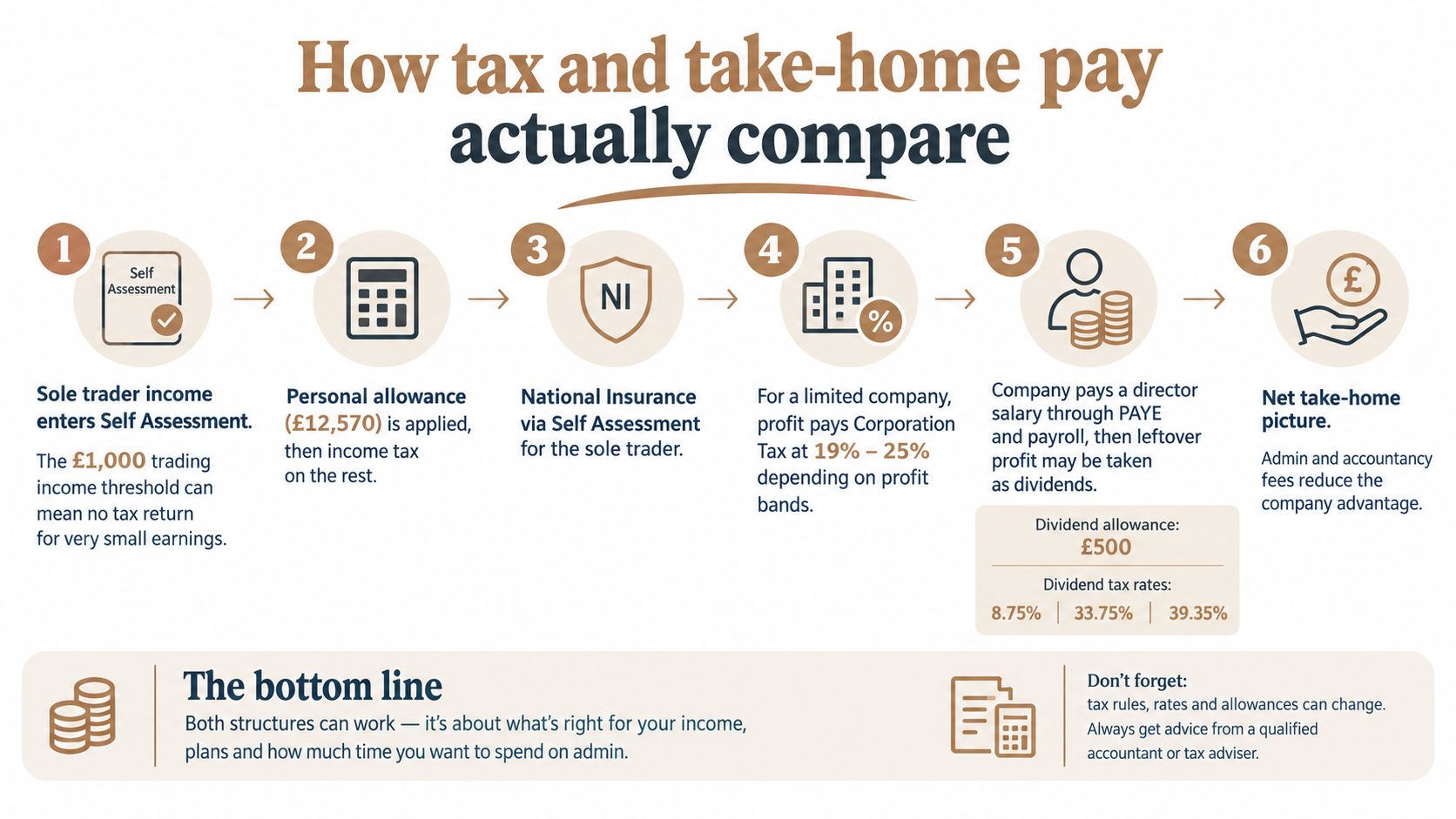
The key differentiator: A sole trader is taxed personally on business profit. A company is taxed first, then the owner may face personal tax when money leaves the company.
A same-profit comparison without fake precision
Suppose a sole trader and a company each generate the same accounting profit before owner extraction. The sole trader calculates taxable profit through Self Assessment and pays personal tax and applicable National Insurance on that profit, even if some cash remains in the business.
The company first pays Corporation Tax. Corporation Tax rates vary by profit band, with the applicable range described in the supplied guidance as 19% to 25%. The owner may then receive a salary and take some remaining profit as dividends. Personal tax depends on how much salary has used the personal allowance, the owner's other income and the dividend tax band.
That means the company can look more attractive where profits are steady and some cash is retained. If the owner withdraws nearly everything for personal spending, the second layer of personal tax and the cost of running the company can reduce or remove the apparent advantage. A founder who needs all available cash shouldn't assume the company route wins.
Company owners should also understand deductible spending and records through this limited company expenses guide. A personalised comparison should model the founder's actual drawings, pension plans, salary and expected profit volatility rather than rely on a single headline figure.
Liability, privacy, credibility and other non-tax trade-offs
Tax is only one lever. The legal and commercial differences can matter more than a small movement in take-home pay.
Liability changes the level of personal exposure
A sole trader isn't legally separate from the business. Business creditors can therefore pursue the owner personally, subject to specific legal protections and circumstances. A limited company generally creates a liability barrier because the company owns the business obligations separately from its shareholders.
That protection isn't absolute. A director can still face personal exposure through a personal guarantee, wrongful conduct or poor separation between company and personal finances. Incorporation reduces a category of risk. It doesn't make careless borrowing or improper conduct safe.
Credibility and privacy pull in different directions
Some larger clients, lenders and investors prefer dealing with incorporated businesses because a company signals formal ownership, continuity and governance. A sole trader can still build a credible business, and the lower administrative friction may be an advantage for local, relationship-led work.
The privacy trade-off is less comfortable. Company details, including information about directors, shareholders and people with significant control, are held on the public Companies House register. A sole trader doesn't create an equivalent incorporation record. Founders who value privacy should understand that incorporation makes business information more visible.
VAT and pensions don't decide the structure alone
Both structures can register for VAT when the relevant conditions apply, so VAT isn't an automatic reason to incorporate. Both can also contribute to personal pensions, although the mechanics differ depending on whether contributions are made personally or through the company.
A company owner also needs to consider employer National Insurance where salary is paid. Pension contributions, VAT treatment, salary arrangements and dividend planning should be modelled together, because changing one part of the extraction strategy can affect the overall result.
Compliance and admin a limited company owner must handle
A limited company creates an ongoing governance job. A sole trader generally avoids company-level filings, while a company owner must keep the public record accurate even when the business is small or dormant. Incorporation therefore brings a timetable, not just a different tax calculation.
A private company must file a confirmation statement at least annually, separately from its accounts. The online fee is £50, while the paper filing fee is £110, according to Companies House filing guidance. The online route is available to eligible private companies, including those with one shareholder, between one and five officers and no more than five people with significant control.
Identity verification adds a personal compliance step. Directors and people with significant control became subject to a legal identity-verification requirement from 18 November 2025, with a 12-month transition period, as described in the Companies House identity-verification guidance. Failure to comply can lead to penalties and restrictions on filing or forming companies. The requirement does not currently apply to sole traders who are not registered with Companies House.
The company calendar
A new company should plan for:
- Companies House records: Keep the registered office, officers, shareholders and people with significant control accurate.
- Confirmation statement: File the statement annually and budget for the online fee.
- Accounts and Corporation Tax: Prepare statutory accounts and submit the Corporation Tax return on the company timetable.
- Payroll: Run PAYE if the company pays a director salary.
- Dormant status: Notify HMRC and Companies House if a company is incorporated but does not begin trading. Otherwise, filing obligations continue.
- Identity verification: Complete the required process for directors and people with significant control.
- Working papers: Maintain clear records supporting accounts, tax returns and company decisions, using suitable limited company accounts working papers.
Sole traders face a separate digital-tax change. Making Tax Digital for Income Tax will apply in stages: above £50,000 from 6 April 2026, above £30,000 from 6 April 2027 and above £20,000 from 6 April 2028, according to HMRC's Making Tax Digital collection. These are future start dates where applicable, not rules that all affected taxpayers already follow. The trigger is qualifying income, not profit. A company sits outside this specific Income Tax MTD regime, although incorporation does not remove every digital record or tax obligation.
Does incorporation still pay once fees and advice are added in
A limited company only wins when the extra structure produces enough value to justify its cost. Test the decision against real cash flow, not headline tax rates. Include accountancy, payroll administration, filing fees, professional advice, dividend tax and the owner's time spent maintaining the company.
A low or volatile-profit business will usually be better as a sole trader. The owner may need every pound for living costs, while a company adds reporting and extraction work before profits are reliable enough to support it.
At profit levels where personal allowances and basic-rate bands do much of the work, the tax difference can be narrow. Incorporation may still make sense for commercial or legal reasons, but professional fees and administration can absorb the apparent saving.
Higher, steady profits make incorporation more attractive, especially when the owner can retain cash for equipment, hiring or working capital. The structure also earns its keep more often when contractual or creditor risk is material, or when formal ownership will help attract investors.
Four patterns deserve separate treatment
- Low profits: Simplicity normally wins. A sole trader avoids company identity checks, confirmation statements and statutory accounts.
- Fluctuating profits: Staying unincorporated avoids committing to recurring company administration before cash flow becomes predictable.
- Steady profits with retained cash: Incorporation can provide a better framework for keeping funds in the business, subject to Corporation Tax and the tax due when money is extracted.
- All profits withdrawn: Salary and dividends can produce a less impressive result once personal tax, professional fees and administration are included.
A spouse or partner involved in the business can change the calculation, as can pension contributions, salary levels and the need to reserve cash for tax bills. The useful question is not which structure has the lowest headline tax. Ask which one leaves the founder with enough cash, appropriate protection and compliance they can manage.
Cost the risk as carefully as the fees. For example, a personal guarantee on a £20,000 overdraft removes the liability barrier for that debt, so guarantee exposure belongs in the incorporation calculation.
The company route also carries a recurring time cost. Identity verification, records, payroll, accounts and tax work may require outside help or several hours of the founder's attention. That cost matters even when the company's cash expenses look manageable.
For a low-profit business, those commitments can outweigh a modest tax advantage. For a profitable business that retains cash and faces meaningful commercial risk, incorporation may still pay. The decision should follow a worked cash-flow comparison, with extraction plans and compliance costs included from the start.
How to choose and when to switch from sole trader
A founder should usually stay a sole trader while profits are low or unpredictable, business risk is limited and simple administration matters more than formal structure. Incorporation deserves serious consideration when profits are consistently strong, the owner can retain some cash, risk has increased or the business needs investment, transferable ownership or stronger credibility with larger clients.
Use these decision triggers
Consider incorporation when:
- Profit is stable: Salary, dividends and retained profit can be modelled rather than guessed.
- Risk is material: A liability barrier has genuine commercial value.
- Growth needs structure: Investors, shareholders or a future sale are realistic possibilities.
- Clients expect it: Some buyers prefer an incorporated supplier.
- Profits stay in the business: The company can fund equipment, hiring or working capital before extraction.
Stay as a sole trader when:
- Profit is modest or irregular: The business doesn't yet support recurring company costs.
- Cash must come out immediately: The second tax layer can weaken the company case.
- The work is low-risk: Limited liability has little practical value for the current activity.
- Admin is already stretched: A company adds governance and filing responsibilities.
- The business is still being tested: A simpler structure may preserve flexibility.
A practical switching checklist
- Model the numbers: Compare personal tax, Corporation Tax, salary, dividends, pensions, fees and retained profit.
- Choose the company name: Check that the proposed name meets the relevant requirements.
- Incorporate and verify: Register the company and complete the identity process for the relevant directors and people with significant control.
- Separate the finances: Open a business bank account and stop treating company money as personal cash.
- Register for the right taxes: Set up Corporation Tax, PAYE, VAT or other obligations where applicable.
- Transfer the operation carefully: Review contracts, assets, insurance and client arrangements before moving activity.
- Tell clients and suppliers: Update invoices and payment details so the legal entity is clear.
The lesson from Rachel Harris's comparison is straightforward: tax is only one part of the decision. The structure should match profit, risk, cash extraction and the owner's appetite for administration. A founder considering wider international structures may also benefit from this overview of LLCs, S corporations and C corporations, while remembering that UK structures follow different rules.
AccountantShe's Financial Wellbeing Routine gives business owners a practical way to organise financial decisions and build regular review habits. Founders who need structure-specific numbers can use that resource as a starting point before taking professional advice.
Accountant She Ltd provides accountancy training, courses, templates and resources for business founders and accountancy professionals, including practical material on sole trader and limited company responsibilities. Visit Accountant She Ltd to review the Financial Wellbeing Routine and find the right next step for the business's structure, cash flow and compliance needs.