An HMRC investigation is usually triggered when something in your figures, filing pattern or records looks unusual, inconsistent or incomplete. Sometimes HMRC also carries out random checks. That means an investigation does not automatically mean you have done something wrong.
This guide is for UK business owners, sole traders, landlords, company directors, content creators, and the accountants who support them. It explains what triggers an HMRC investigation, the most common red flags, how an HMRC tax investigation usually works, and what practical steps help you prepare before HMRC ever contacts you.
It also covers what to do if a letter arrives, where HMRC investigation insurance may help with professional fee costs, and why good records matter more than trying to find a clever way to avoid scrutiny.
“Some investigations are genuinely random and you can’t control that. But most investigations are absolutely not random.”
The aim here is not to promise a way to avoid HMRC contact altogether. The aim is to help you keep clean evidence, understand the common tripwires, and respond calmly if HMRC asks questions.
Table of Contents
- Who this guide is for and what it covers
- What counts as an HMRC investigation
- What triggers an HMRC investigation
- How an HMRC tax investigation usually works
- How to avoid avoidable HMRC scrutiny
- What to do if HMRC opens a check or enquiry
- Your rights, time limits and when to push back
- Penalties, settlements and HMRC investigation insurance
- Key lesson takeaways
- Conclusion and next step
Who this guide is for and what it covers
If you have received a letter from HMRC, or you want to reduce the chances of a stressful compliance problem later, the first step is to understand what kind of contact you are dealing with. A penalty notice, an information request, a compliance check, and a formal enquiry are not all the same thing.
That distinction matters because the right response depends on what HMRC has actually sent.
A sensible starting point is to stay calm and work through five basics:
Identify the document: Check whether it refers to a penalty, compliance check, enquiry, information notice, or Code of Practice 9.
Check the deadline: Record the reply date and any separate appeal or review deadline.
Keep the evidence together: Save the letter, attachments, tax return, workings, and supporting records in one place.
Tell your accountant early: Early review often prevents rushed explanations and missed procedural options.
Do not guess: If a figure or transaction is unclear, check it before replying.
Practical rule: A prompt, accurate and proportionate response is usually better than a long explanation written under pressure.
This article is educational, not personal tax advice. Once HMRC opens a formal process, the right next step depends on the tax involved, the periods under review, the wording of the notice, and the behaviour HMRC may be considering.
What counts as an HMRC investigation
Many business owners use the phrase HMRC investigation to describe any worrying HMRC letter. In practice, some contact is automated, some is routine compliance work, and some is a formal investigation into a tax position.
HMRC reported issuing 8,128,750 automated penalties, penalty points and default surcharges in 2025-26, compared with 306,000 compliance checks in the same period, according to its performance analysis. That helps explain why the label on the letter matters.
| Category | Typical first contact | Who leads | First response focus |
|---|---|---|---|
| Automated compliance action | Penalty, surcharge or penalty-point notice | Automated HMRC process | Check the filing, payment or reasonable-excuse position |
| Routine compliance check | Letter or information request about a return or debt | HMRC compliance officer | Identify the tax period, records requested and deadline |
| Formal tax investigation | Enquiry correspondence or specialist contact | Compliance or specialist team | Establish scope, preserve evidence and coordinate replies |
| Criminal investigation | Serious fraud-related contact | Fraud Investigation Service or criminal investigators | Obtain specialist advice immediately and avoid informal explanations |
A routine check may be resolved by producing records and correcting an error. A formal investigation may involve wider questions about income, expenses, transactions, or behaviour. The first task is to establish the scope, not assume the worst.
For suspected deliberate tax fraud, HMRC may use Code of Practice 9, often called COP9. HMRC usually uses civil powers first, but these cases need specialist handling from the start.
What triggers an HMRC investigation
The short answer is that there is no single trigger. HMRC can open a check because something does not match information it already holds, because a claim looks unusual, because filing behaviour suggests a compliance risk, because an industry is under closer review, because of a tip-off, or simply because the case was selected at random.
Rachel Harris puts it simply:
"Most HMRC investigations start because something looks off. Something triggers a tripwire in the HMRC system."
If you are asking how to avoid HMRC investigation, the honest answer is that you cannot guarantee prevention. What you can do is reduce avoidable risk by filing on time, reconciling figures properly, keeping good records, and making unusual positions easy to explain.
Common red flags HMRC may look at
Some patterns come up again and again when HMRC reviews a business tax position.
| Risk factor | What HMRC may want explained | Useful business habit |
|---|---|---|
| Late or missing filings | Why the deadline was missed and whether the return is complete | Keep a filing calendar and chase missing records early |
| Unusual claims or movements | The basis for a large expense, relief, loss or year-on-year change | Keep the calculation and source documents with the return workings |
| Mismatched records | Differences between returns, accounts, payroll, VAT or third-party data | Reconcile submissions before filing |
| Poor record keeping | Whether the figures can be traced back to underlying evidence | Keep invoices, bank records, payroll data and explanations together |
| Cash-heavy trading | Whether all sales and takings have been recorded | Keep daily till, invoice and banking records |
| VAT refund claims or irregular VAT patterns | Whether the input tax position is supported and consistent | Keep digital records current and preserve a clear audit trail |
| Off-payroll working or status issues | Why a worker was treated in a particular way | Document the facts and review changes in the engagement |
| Property or capital gains matters | Ownership, dates, costs, use and disposal calculations | Retain contracts, completion statements and improvement evidence |
| Repeated errors | Why the same issue keeps happening across periods | Fix the process, not just the individual return |
| Round numbers everywhere | Whether estimates were used instead of actual records | Work from real records and keep the workings |
| Big sudden swings in profit, income or costs | Why the figures changed so sharply from earlier periods | Keep a short file note explaining one-off events |
| Industry spot checks | Why your margins or reporting differ from similar businesses | Understand your benchmarks and keep evidence for differences |
The lesson source also highlights that newer or fast-changing sectors can face closer scrutiny because HMRC has fewer historic benchmarks. Content creators are a good example. That does not mean those businesses are doing anything wrong. It means HMRC may want more information while it builds a picture of how that sector works.
"The third is sloppy, late, or inconsistent filing that makes you look disorganized."
A late return is not proof of underpaid tax. A large claim is not automatically wrong. The real risk increases when the business cannot explain the figure, cannot produce the records, or gives inconsistent answers.
Good housekeeping solves a very common problem. An owner often remembers why a transaction happened commercially, but cannot reconstruct the tax treatment later. A short note made at the time, stored with the supporting document, is often more valuable than a confident explanation written years after the event.
Can HMRC investigate at random?
Yes. Random checks are part of the compliance landscape. That is one reason it is unhelpful to think only in terms of guilt or innocence. A business can file on time, pay the tax shown, and still receive questions.
That does not mean every letter is serious. It does mean every letter should be read carefully.
How an HMRC tax investigation usually works
An HMRC tax investigation usually develops in stages. HMRC selects a case, opens contact, reviews information, asks follow-up questions, and then closes the matter through confirmation, correction, assessment, or settlement.
HMRC's annual report recorded £48.0 billion in compliance yield during 2024-25, above its £45.4 billion target, with an average return of £23 for every £1 spent on its compliance workforce, according to the chief executive's performance report. That figure covers a wide range of compliance activity, not just formal tax investigations.
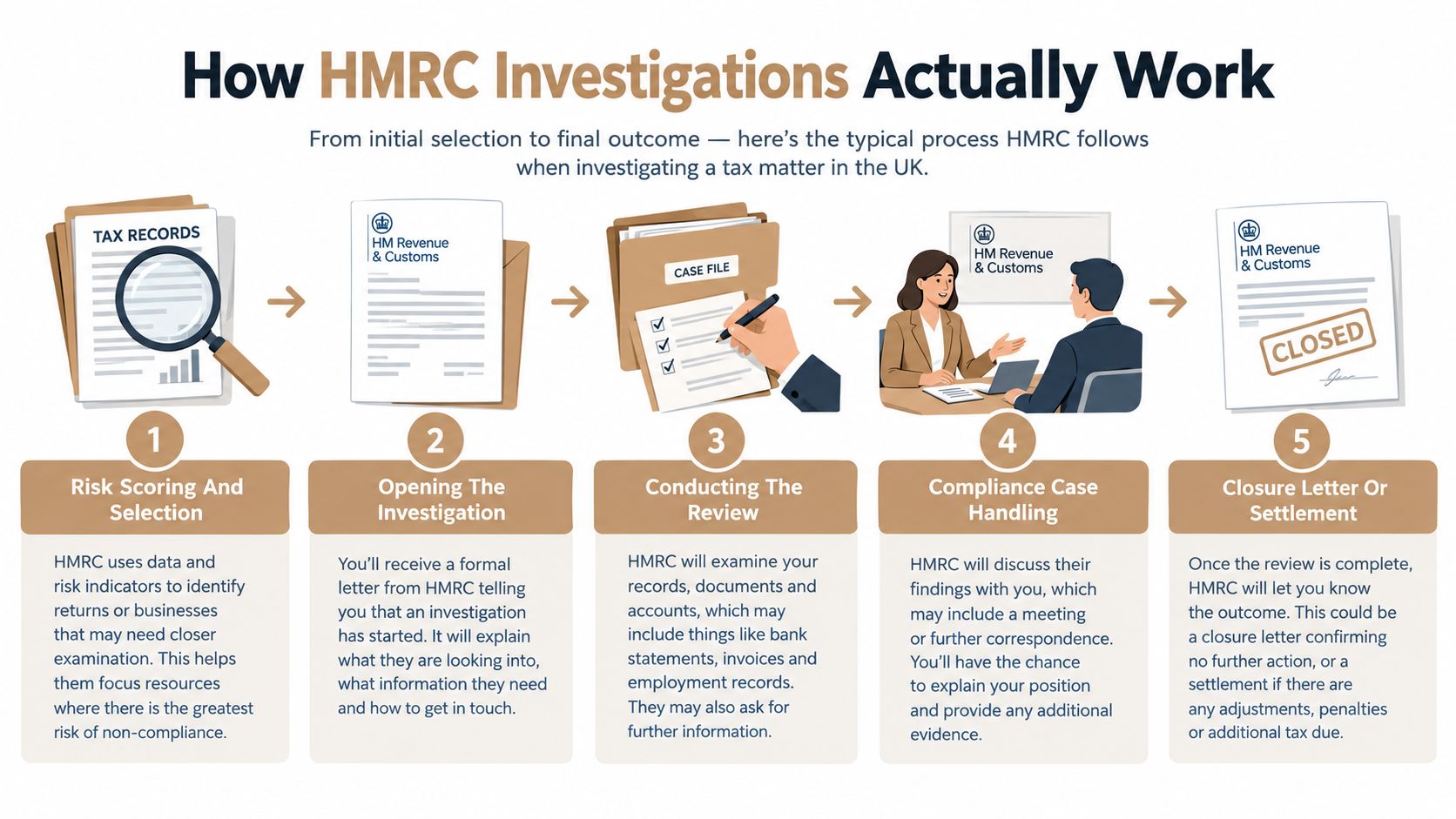
The five practical stages
1. Selection and opening
HMRC identifies a risk or selects a case for review, then sends correspondence stating what it wants to examine. The opening letter should be read closely because the tax, period and issue define the immediate scope.
2. Evidence gathering
The officer may ask for accounts, bank records, invoices, receipts, payroll records, VAT data, or explanations for specific entries. If there is a call or visit, keep a written note of what was requested and agreed.
3. Review and challenge
HMRC compares the evidence supplied with the return and may ask follow-up questions. The strongest responses separate confirmed facts, calculations, and points still being checked.
4. Specialist handling where needed
Serious fraud concerns may be handled through COP9. HMRC's Fraud Investigation Service technical note records substantial compliance yield from fraud investigation activity, which underlines why deliberate-behaviour cases should not be answered casually.
5. Closure or settlement
The matter may end with no change, a correction, an amended return, an assessment, or a negotiated settlement. Clear records and organised communication help keep track of what has and has not been answered.
Businesses that want stronger day-to-day systems can also use email templates for tax registrations and related contact, while keeping any live investigation response under appropriate professional review.
How to avoid avoidable HMRC scrutiny
You cannot guarantee that HMRC will never contact you. But you can make your business much easier to understand and much easier to defend.
Rachel's point here is practical, not dramatic:
"It's actually just being really genuinely on top of things."
A simple readiness framework is:
1. Reconcile before filing
Make sure the return agrees to the accounts, payroll records, VAT submissions, and any supporting schedules. If something is unusual, investigate it before it goes in.
2. Keep working papers
Do not rely on the tax return alone. Keep the calculations, notes and source documents that explain how key figures were arrived at.
3. Record unusual decisions at the time
If a claim is large, a status decision is borderline, or a transaction is one-off, keep a short note explaining the facts and the tax treatment.
4. Keep digital and paper records accessible
If evidence exists but cannot be found, the practical outcome can be almost as bad as having no evidence at all.
5. File on time, every time
Repeated lateness creates avoidable stress and makes the business look less controlled than it may really be.
6. Use actual numbers, not rough guesses
The lesson specifically warns about round figures that look invented. If you need to estimate anything, document why and how.
7. Get advice before you guess
If you are unsure about a tax treatment, it is safer to ask than to improvise.
"Boring is exactly what keeps you safe with HMRC."
For many business owners, building a better routine is more realistic than trying to create perfect records overnight. The Financial Wellbeing Routine is a useful next step if you want a more consistent process around records, deadlines and financial visibility.
What to do if HMRC opens a check or enquiry
If HMRC contacts you, the goal is not to reply instantly. The goal is to reply accurately.
Start by confirming:
-
which tax is involved
-
which period is under review
-
what documents or explanations are being requested
-
what the deadline is
-
whether appeal or review rights apply separately
Then gather the evidence before committing to a narrative.
The source lesson makes an important point here. Getting a letter does not mean disaster. It often means HMRC wants to understand something. Businesses usually cope best when they can stay calm, produce the records, and explain the figures clearly.
"It doesn't mean you've done something wrong."
Read the request properly
HMRC guidance says an information notice should identify documents or information as clearly as possible. Where practicable, it should specify identifiable documents, or describe the material narrowly and limit the types of records requested. HMRC may require an original electronic document or an electronic copy where it has reasonable grounds to do so, as explained in the Compliance Handbook guidance on information notices.
That means a business should avoid sending a disorganised data dump. Build a request schedule instead. For each item, record:
-
whether it exists
-
who holds it
-
what period it covers
-
whether the version supplied is complete
-
whether any explanation is needed alongside it
If a request seems too broad, that point should be raised clearly and professionally.
A practical response checklist
-
Tell your adviser early: This matters even more if HMRC suggests deliberate behaviour.
-
Define the scope: Identify the tax, periods, transactions and documents covered.
-
Check reasonableness: Ask whether each requested item is within your power or possession and reasonably required.
-
Record deadlines: Keep reply, appeal and review dates separately.
-
Ask for time early if needed: Extensions are easier to request before a deadline is missed.
-
Keep a paper trail: Save letters, emails, documents supplied, meeting notes and explanations.
-
Consider next-step rights: Penalty disputes, formal assessments and information notices can have different routes and deadlines.
-
Plan for payment if needed: If additional tax, interest or penalties may be due, review cash flow early.
Do not send a speculative explanation simply to fill the silence. A short acknowledgement followed by a properly checked response is usually safer than an immediate answer based on memory.
Your rights, time limits and when to push back
You can appoint a professional representative to handle routine communication with HMRC. That does not remove your responsibility to provide accurate information, but it often improves the quality and consistency of the response.
The correct approach is not to resist every request. It is to test each request against what HMRC reasonably requires and to challenge unclear or disproportionate demands in a professional way.
HMRC's guidance says an information notice must identify information or documents clearly and narrowly, while a requirement to produce a statutory record has no right of appeal. The central test remains whether HMRC reasonably requires the material, as explained in its Compliance Handbook information notice guidance.
Time limits also matter. HMRC generally has:
-
4 years from the end of the relevant tax year where an underpayment is not linked to careless or deliberate conduct
-
6 years where the loss of tax was caused by carelessness
-
20 years for deliberate behaviour, failure to notify a liability, or certain undisclosed avoidance arrangements
-
12 years in certain offshore Income Tax, Capital Gains Tax and Inheritance Tax cases
These limits are reflected in HMRC's Self Assessment legal framework guidance. Time-sensitive facts should always be checked against the current HMRC position at the point advice is taken.
Working papers for the return, including Self Assessment tax return working papers, make it easier to show how figures were prepared and what evidence supported them.
Penalties, settlements and HMRC investigation insurance
An HMRC investigation can end with no change, an amended return, extra tax and interest, or a penalty. The result depends on the facts, the quality of the records, and how the taxpayer responds.
HMRC's published material states that penalties for undisclosed deliberate behaviour can reach 200% of the tax due in some circumstances, as referenced in its annual reporting material.
COP9 cases need particular care because they concern suspected deliberate tax fraud. HMRC usually offers a civil route first, but it can still pursue criminal proceedings. A COP9 letter should never be treated like a routine admin query.
Is HMRC investigation insurance worth it?
HMRC investigation insurance is not an HMRC product. It is a commercial insurance product that may help cover eligible professional fees arising from a compliance check or enquiry.
That matters because some business owners misunderstand what the cover does. It usually does not:
-
stop HMRC opening a case
-
remove tax that is actually due
-
remove penalties or interest
-
guarantee cover for every type of professional cost
The lesson source describes investigation insurance as a practical way for a business to protect itself against the professional cost of handling an enquiry. In simple terms, if cover is in place and the policy responds, your accountant may be able to deal with the investigation and claim eligible fees from the insurer instead of billing you directly.
Whether it is worthwhile depends on the policy wording, exclusions, notification requirements, fee limits and the complexity of your business affairs. A company with multiple tax obligations and limited spare cash for unexpected adviser fees may view it differently from a simpler business.
Insurance can be useful, but it is not a substitute for good records or prompt action.
If you need tailored tax support, especially where the facts are disputed or the sums are material, the next step may be specialist advice through a trusted referral route such as StriveX.
Key lesson takeaways
-
HMRC contact does not automatically mean wrongdoing. Some checks are random, and many are simply requests to understand a figure or filing position.
-
Most investigations start when something looks off. Inconsistencies, unusual movements, round numbers, late filing and weak records all increase attention.
-
Your industry can affect scrutiny. Newer sectors or sectors with weaker benchmarks may see more spot checks.
-
Clean records matter more than confident reassurance. If you can show how the figures were prepared, the conversation becomes easier.
-
You cannot promise prevention. You can only reduce avoidable risk and improve your readiness.
-
A calm, accurate response usually works better than a rushed one. Read the request properly, define the scope, and gather evidence before explaining.
-
Investigation insurance may help with professional fees. It does not stop HMRC opening a case or remove tax, penalties or interest.
-
Financial confidence is protective. The better you understand your numbers, the less stressed and more in control you are if questions arise.
Conclusion and next step
If you want the clearest answer to what triggers an HMRC investigation, it is this: HMRC usually acts when something needs to be checked, and sometimes it checks at random. The businesses that cope best are not always the ones with perfect records. They are the ones that can quickly show how the figures were prepared, where the evidence sits, and who is coordinating the response.
If your systems feel reactive, your next step is to strengthen them before a letter arrives. Start with the Financial Wellbeing Routine to build a steadier approach to records, deadlines and financial visibility. If HMRC has already made contact and the issue needs tailored input, get support from your accountant or a specialist tax adviser through StriveX before committing to a position.
Accountant She Ltd provides practical accountancy training, courses, templates and resources for accountants, practice owners and business founders seeking clearer systems for compliance and financial management. Visit Accountant She Ltd for resources that support better HMRC response readiness.