
How to Price Accounting Services without Undervaluing Your Firm
If you want to price accounting services without undervaluing your firm, start by pricing the outcome, the scope and the capacity required to deliver it, not just the hours on a timesheet.
This guide is for UK accountancy practice owners who know their fees no longer reflect the work, the pressure on the team or the value clients receive. Using Rachel Harris's pricing framework from the Practice Owners Podcast, this article sets out a practical step-by-step approach to moving away from reactive hourly billing and towards a clearer, more profitable accounting fee structure.
At the centre of Rachel's message is a simple shift in thinking: stop treating pricing as a rate card exercise and start treating it as a commercial system. That means understanding what you actually earn, what each service costs to deliver, what clients truly value and when scope changes should trigger a fee review.
The relevant episode is here:
https://practiceownerspod.substack.com/p/why-hourly-rates-break-scaling-firms-761
Table of Contents
- Why hourly billing causes firms to undervalue their work
- How to price accounting services using a practical 4-step framework
- What a strong accounting fee structure needs to include
- A simple worked example for pricing accounting services
- How to review underpriced clients without creating friction
- Your accounting pricing checklist
- Conclusion
- Full episode transcript
Why hourly billing causes firms to undervalue their work
Rachel Harris opens the episode by positioning repricing as a practical growth activity, not an administrative chore. Her argument is that hourly billing keeps firm owners trapped because revenue remains tied to time, even as the client expects certainty, access and better outcomes.
"It's one of the most common pricing models in our industry. It's exactly how I was trained as an accountant. But it's completely outdated."
That matters because the more efficient your systems become, the less sense it makes to base your pricing on hours alone. If your team becomes faster, more accurate and more proactive, a pure hourly model can punish the very efficiencies you have worked hard to build.
Rachel puts it plainly:
The UK guide to bookkeeping and compliance fees
"You're essentially capping your earning potential at the number of hours that you can work."
This is also where many firms quietly undervalue themselves. A client may appear small on paper, but still consume large amounts of capacity through messy records, repeated queries, delayed information, partner involvement or expanding compliance needs. When the fee stays static but the service evolves, margin disappears.
A better model starts by asking four commercial questions:
-
What outcome is the client buying?
-
What work is included in the current fee?
-
What capacity does that work consume?
-
What should trigger a reprice or scope review?
Those questions create a stronger basis for pricing accounting services than a simple charge-out rate.
How to price accounting services using a practical 4-step framework
The episode is built around a repricing challenge. Rather than jumping straight to new packages or higher fees, Rachel starts with measurement. That makes this a useful framework for practice owners who want a pricing reset grounded in real numbers.
Step 1: Calculate your effective hourly rate
Rachel's first exercise is to work out what you are actually earning for your time. This is not to justify hourly billing as a long-term model. It is to expose whether your current pricing reflects reality.
Her method is simple:
-
Write down the total revenue generated over the last 12 months.
-
Calculate the total hours worked in that period, including billable and non-billable time.
-
Divide total revenue by total hours worked.
That gives you your effective hourly rate.
Rachel's example uses £120,000 of annual revenue and 2,500 hours worked. That gives an effective hourly rate of £48 an hour.
The reflection point is the important part. Is that figure what you thought you were earning? Is it what you would want to earn for the level of responsibility involved in running a firm?
For firms with teams, Rachel also highlights a practical margin sense check. Many service businesses work on a rough one-third model, one third for wages, one third for overhead and one third for profit. If a team member's work is not generating enough to cover that structure, your pricing needs attention.
"if you're not, it's a very clear sign that your pricing needs adjusting"
The UK accounting revenue-gap survey
Step 2: Review profitability by service line
The next step is to stop looking only at total monthly revenue and start breaking down profitability by service.
Rachel recommends listing every current service, such as:
-
bookkeeping
-
VAT returns
-
payroll
-
year-end accounts
-
tax returns
-
advisory
For each service, review:
-
the revenue it generates
-
the time it takes to deliver
-
any direct costs, such as software or subcontractor fees
Her formula is straightforward in concept:
Profit per service = revenue – direct costs – time cost
In the episode, Rachel uses this example:
-
Fee for year-end accounts: £1,500
-
Direct costs: £100
-
Time spent: 15 hours
-
Effective hourly rate used as the time cost: £48
Using that logic, the exercise shows how quickly a service that looks healthy on the surface can become less attractive once delivery cost is included.
This is often where hidden underpricing appears. A service may be busy, familiar and easy to keep selling, but still weak on profit once real time and cost are accounted for.
Step 3: Price the outcome, not just the task
This is the mindset shift at the centre of the episode.
Rachel says:
"stop selling time and start selling outcomes"
She encourages practice owners to map each service in two parts:
-
the tasks involved in delivering it
-
the outcome the client receives
For example, monthly bookkeeping might include reconciling bank statements and preparing management accounts. But the client is not really buying reconciliations. They are buying clearer financial visibility and better decisions.
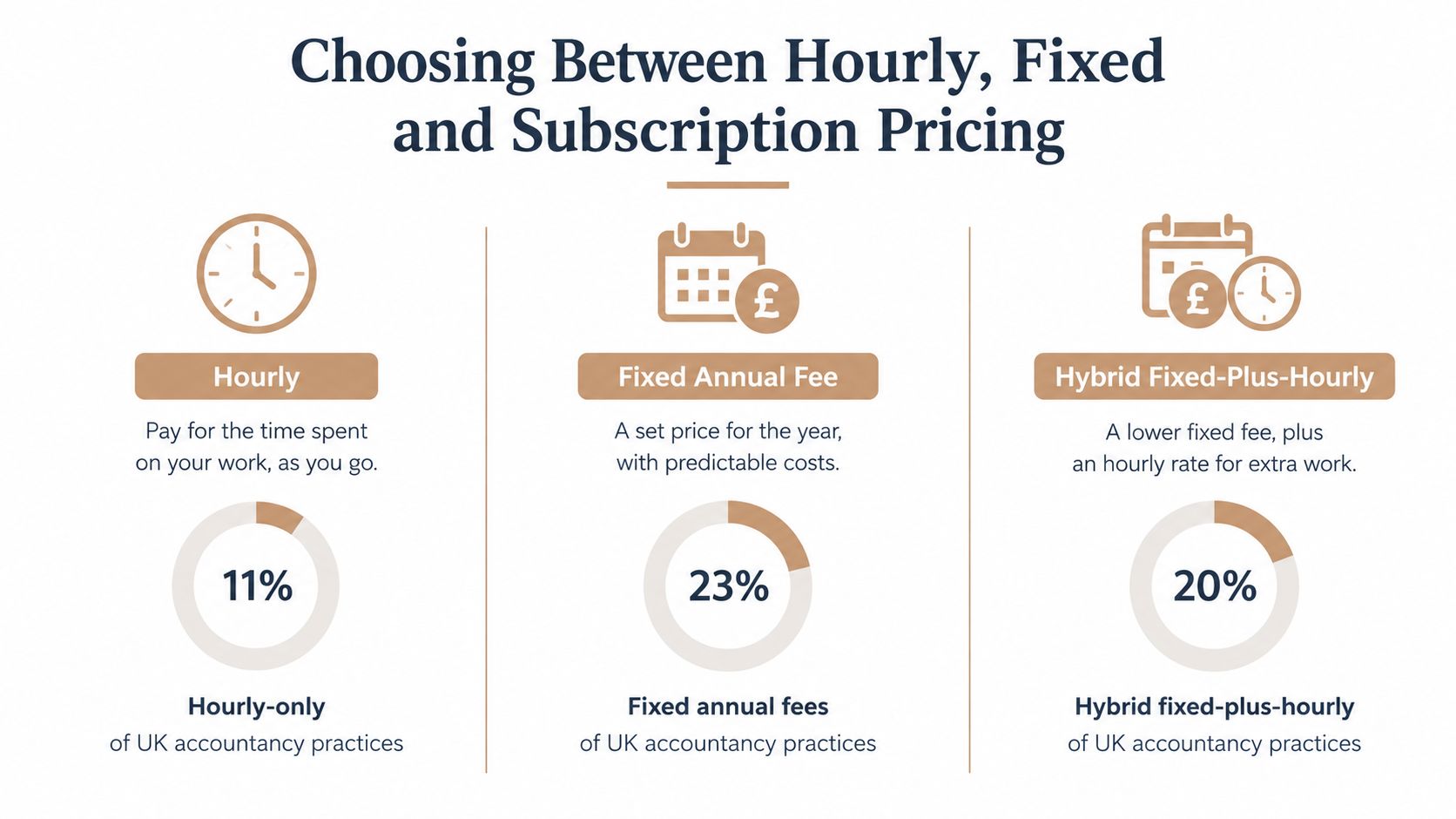
Rachel gives a useful repositioning example. Instead of presenting a service as monthly management accounts, position it as:
"gain clarity on your business performance every single month"
This matters because clients usually value certainty, confidence and reduced stress more than process language. In Rachel's words, they are also buying "the headspace and the wellbeing that they get back as a result of your work."
That does not mean abandoning discipline around cost. It means using value to frame the offer, while still checking that the work is commercially viable to deliver.
Step 4: Turn services into clear packages
Once you understand what each service costs and what outcome it delivers, the next move is to package it in a way clients can understand.
Rachel's view is that bundling simplifies pricing and helps clients see value more clearly. It also supports recurring revenue and makes your offer easier to market.
Her example uses three levels:
-
a core package with essential compliance services such as VAT returns and year-end accounts
-
a premium package that adds bookkeeping, cash flow forecasting and extra tax planning
-
a VIP package that adds regular strategy meetings and bespoke tax advice
A package structure like that gives clients a clearer choice and gives your firm cleaner scope boundaries.
What a strong accounting fee structure needs to include
An effective accounting fee structure is not just a monthly number. It needs clear assumptions behind it so the fee can hold when the client changes.
Scope boundaries
Every proposal should spell out what is included, what is excluded and what assumptions the fee depends on.
For example, state:
-
expected transaction volume
-
payroll headcount band
-
whether VAT returns are included
-
what level of queries or meetings is covered
-
response times and information deadlines
If those assumptions change, the fee should be reviewed before the extra work is absorbed.
Capacity and senior input
Rachel's examples make clear that pricing needs to reflect more than delivery time. Senior review, partner access and reactive support all consume capacity. If those inputs become routine, they must be reflected in the price.
Direct costs and delivery cost
Even when using value-led positioning, firms still need a hard commercial floor. Include software, subcontractors, admin effort and the delivery time involved. Otherwise a premium-sounding package can still erode profit.
Review triggers
Scope changes should not rely on memory or goodwill. Define the events that trigger a review, such as:
-
VAT registration
-
extra employees
-
higher transaction volume
-
messy records at handover
-
additional reporting requests
-
regular advisory access
That gives the team a consistent basis for repricing.
The guide to accountant costs for small businesses
A simple worked example for pricing accounting services
Suppose a limited company wants annual accounts, corporation tax support, quarterly VAT returns, monthly bookkeeping and light advisory access.
A defensible approach could look like this:
-
Estimate the recurring delivery time for bookkeeping, VAT, accounts preparation, review and client communication.
-
Add direct software and admin costs.
-
Sense-check the result against your effective hourly rate and target margin.
-
Define the client outcome, such as compliance confidence, monthly visibility and access to support.
-
Present the price as a package with clear assumptions.
If the records are incomplete at onboarding, quote the cleanup separately first. If the client later adds payroll, management reporting or more frequent support, move them to a revised package or issue a scope change.
That is the practical link between how to price accounting services and how to protect profitability.
How to review underpriced clients without creating friction
Rachel frames repricing as a disciplined exercise, not a confrontation. The article draft already included useful fee review ideas, and the transcript supports that direction.
A good review process is:
-
Audit what the client currently pays.
-
Compare it with actual workload and service scope.
-
Identify where tasks have expanded but fees have not.
-
Reframe the offer around outcomes and package fit.
-
Explain the revised fee based on changed requirements.
ICAEW guidance on pricing, fees and charge-out rates
This is also where Rachel's warning on underpricing matters most. In the episode, she says:
"clients who are price sensitive do not value your expertise"
That is not a reason to be careless with pricing conversations. It is a reminder that chronic discounting can distort your client base and undermine your firm's positioning.
For tailored help with the process, the Pricing Strategy Workshop is the most relevant next step. It builds on the same themes Rachel covers here, pricing confidence, service packaging and stronger commercial boundaries.
Your accounting pricing checklist
Use this checklist to reset pricing in a controlled way:
-
Calculate your effective hourly rate: Work out what the business really earns per hour across all time worked.
-
Review services line by line: Identify which services are profitable, underpriced or poor uses of capacity.
-
Define the client outcome: Replace task-led descriptions with outcome-led language.
-
Bundle services clearly: Create simple package options that reflect client needs at different stages.
-
Document assumptions: Record transaction levels, payroll limits, VAT work, meetings and response times.
-
Set review triggers: Decide in advance what changes will require a repricing conversation.
-
Train the team: Make sure anyone discussing proposals can explain scope and when fees change.
-
Review regularly: Repricing works best as an ongoing discipline, not a panic response after a difficult busy season.
If you want a broader practice system for pricing, delivery and growth, Practice Makes Perfect is the natural follow-on resource.
Conclusion
If you want to stop undervaluing your firm, start by measuring what your pricing is really producing. Then review service profitability, define the outcomes clients are paying for and package your work with clear scope boundaries.
Rachel Harris's framework is useful because it is practical. It does not start with theory. It starts with your current numbers, your current workload and the commercial reality inside the practice.
Your next step is simple. Pick one service, calculate its true delivery cost, define the outcome it creates and decide whether the current fee still makes sense.
Accountant She Ltd provides practical training, templates and resources for accountants, bookkeepers and practice owners. Explore the Pricing Strategy Workshop if you want help reviewing and restructuring fees, or Practice Makes Perfect for broader practice support.
Full episode transcript
(00:00:00)
Welcome to the Accountant She Practice Owners podcast with me, your host, Rachel Harris.
This podcast exists to help you unlock my secrets to running, starting and scaling a seven-figure accounting firm.
Join me as I share insider knowledge and proven strategies to elevate your accounting firm. Whether you're seeking technical information, industry updates or expert advice, this podcast is your blueprint to perfecting your own firm.
Gain the insights you need all in one place. So if you're ready to invest in your business and achieve success, let's dive in.
(00:00:39)
Welcome back to the Practice Owners Podcast. If you thought we would take it easy and relax once we were done with January, you should have known better. This is officially week one of our four-week repricing challenge, and I am so excited to get started.
You might be thinking, Rach, this is the last thing I want to do after a hectic January. But this is actually the best thing that you could possibly do after a hectic January.
The mantra that I want you to take into 2025 is to take action, and this is where that transformation begins.
Today we are diving into the foundations of pricing. I'm talking about getting you out of that hourly rate trap and shifting you to a value-based pricing model that allows your firm and, most importantly, your wellbeing to thrive.
Over the next four weeks, I have got jam-packed content for you and every single week we are covering the principles. I have built some activities for you to do based on the work that I have done every single year for the last four years to make that transformation happen.
This week we are talking all about value-based pricing. I've got some exercises, I've got some homework for you to take away and this is the repricing challenge because every single week we are using the Substack community to build that accountability and celebrate our wins along the way.
Week two, next Monday, we're talking all about packaging up your services and creating offers that drive recurring revenue based on your value. Week three, we're talking about overcoming objections. This is the bit that most accountants are allergic to. It is how to sell confidently to your clients.
The Profitability Playbook for Accountants and Bookkeepers
Finally, week four is how you mark this February as the era that your pricing evolved. I am talking about fine-tuning that strategy to help your practice to scale.
And remember why we're all here. The Practice Owners Podcast exists to get you feeling better about your business.
(00:03:19)
In today's episode, you're going to learn all about why hourly billing caps your earning and how you can move over to value-based pricing. You're going to learn the psychological impact of pricing on clients' perception and how to position yourself as a premium provider.
You're also going to learn the risks of underpricing and how this is going to affect your profitability and your client base.
Once we've done that, I'm going to show you how to calculate your effective hourly rate to see what you are actually earning for your time right now.
Then we're going to audit your current pricing structure and identify where you are leaving money on the table.
Once we've done that, we're going to break down your services line by line to uncover the real outcomes that clients value. And we're going to start selling that transformation, not simple tasks.
So by the end of this week, you are going to have clarity on what you are currently charging, the true profitability of your services and how to stop selling time and start selling outcomes.
(00:04:42)
So I'm going to start by addressing the elephant in the room, which is hourly billing. It's one of the most common pricing models in our industry. It's exactly how I was trained as an accountant. But it's completely outdated.
Why? Because it directly ties your revenue to your time. You're essentially capping your earning potential at the number of hours that you can work.
If you think about it, hourly billing rewards inefficiency. The longer a task takes you, the more you earn. But clients are not paying for your time. They are paying for the outcome that you deliver, the headspace and the wellbeing that they get back as a result of your work.
Now let's talk about client perception, because pricing isn't just a number, it sends your clients a message. If you price yourself too low, clients will actually perceive your service as less valuable.
(00:06:17)
A little story on this. I used to mentor a firm owner who was starting their firm and, completely by chance, we both quoted for the same client. Our firm's quote was four times my mentee's, and we won the work.
So hourly pricing doesn't work. What's the alternative? The alternative to hourly fees is value-based pricing.
Value-based pricing means setting your fees based on the value that you deliver to your clients.
Let me give you an example. Imagine a client comes to you with a very messy set of accounts that they need to clean up before year end. If you are billing hourly, you might charge £500 for 10 hours of work. But if you're using value-based pricing, you'd consider the outcome.
You're helping this client avoid penalties, you're helping them to improve their cash flow and you're supporting them to make better future financial decisions. So you might decide to charge £1,500 for the outcome. The client would gladly pay that fee because of the value that they are receiving.
(00:07:25)
Over the next four weeks, we're not just talking about pricing. We are also diving into communicating your value and handling objections.
Now let's talk about the risks of underpricing in your firm. This might sound obvious, but this is so important. Underpricing not only reduces your profitability, but it also attracts the wrong type of clients.
GOV.UK's VAT registration guidance
Clients who are price sensitive do not value your expertise. I'm going to say it again, clients who are price sensitive do not value your expertise. Write that on a Post-it note and stick it to your computer screen for the next four weeks.
So this week, given what we've learned so far, we are going to audit your current pricing structure. We're going to look at what you are currently charging and why. Then we're going to identify services that could be bundled into packages. We're then going to challenge ourselves to stop selling time and start selling outcomes to clients.
(00:09:09)
This is a basic but one of my favourite exercises because it is going to give you a clear picture of what you are really earning for your time.
Here's what I want you to do. Write down the total revenue that you have generated in the last 12 months. Then calculate the total number of hours that you've worked in the same period. This includes billable and non-billable hours.
Then divide your total revenue by the total number of hours that you've worked to calculate your effective hourly rate.
Let me give you an example. Imagine you've generated £120,000 in revenue over the last 12 months and you've worked 2,500 hours in total. When you divide £120,000 by 2,500 hours, your effective hourly rate is going to be £48 an hour.
Now here's the kicker. Is that hourly rate what you thought you were earning? Think about the hourly rate that you could earn in employment. If this is lower than you expected, a big reflection point for you this week is: are you happy with that number? If you're not, it's a very clear sign that your pricing needs adjusting.
The earning per hour is really important for people with teams as well because lots of service-based businesses operate on a third, a third, a third. A third for that person's wages, a third for overheads and a third for profit. So if you have a team and you're calculating this, you would want the effective hourly rate to be triple the hourly rate of the person that's working for you. If that's not the case, that's another signal that you should be adjusting your pricing.
(00:10:52)
Now we've got your effective hourly rate. The second exercise that we're going to do is break down the profitability of the services that you offer.
Data dictates everything. It can help you improve, it can help you spot risks and it can help you reconcile feelings that you might have as well.
How and when to increase your prices
This exercise is going to help you spot services that are underpriced or maybe not even worth your time.
Make a list of all of the services that you currently provide, for example bookkeeping, tax returns and advisory. For each service, calculate the time that you spend delivering it and the revenue that it generates.
Then subtract any direct costs associated with delivering that service, like software subscriptions or subcontractor fees.
Consider the formula that the profit per service equals the revenue generated by that service minus the direct costs minus the time costs, which is going to be your effective hourly rate multiplied by the time you spend delivering that service.
An example would be if you charge £1,500 for year-end accounts and you spend 15 hours on it. You also have £100 in direct costs. Your profit would look like £1,500 minus £100 minus 15 hours at £48, which gives you a profit of £680.
Now we're going to look at the numbers per service. Which services are the most profitable? Which ones are dragging down your overall profitability? This exercise is going to help you make data-driven decisions about which services to keep, reprice or eliminate.
If you're anything like us, our portfolio has services that perform higher than others. But when we package them together, we really help to understand how they can work together and how, if we can sign a client based on a lower profit margin job, we then have an expectation to upsell higher profit margin jobs too. Again, knowing the margins can help you make those decisions.
(00:13:10)
The third exercise we're going to look at is one of my favourites and this exercise is all about shifting your mindset from selling time to selling outcomes.
Clients don't care how many hours you spend on their accounts. They care about the results that you can deliver to them.
Take the list of services that you've just mapped out and list the tasks involved in delivering them. For each service, write down the outcome that your clients achieve.
For example, if the service was monthly bookkeeping, the tasks would be to reconcile the bank statement and prepare management accounts. The outcome for that bookkeeping would be that clients gain clarity on their financial performance and we support them to make informed business decisions.
Now ask yourself: are you actually communicating those outcomes to your clients or are you just listing the tasks?
When you're talking about your services, it's so important to focus on the transformation your clients are going to experience. For example, instead of saying monthly management accounts, you can say, gain clarity on your business performance every single month.
(00:14:18)
I've got another exercise for you and this is the last exercise.
Finally, I want you to think about how you can bundle services into packages. Bundling not only simplifies your pricing, but it can also make it easier for clients to see the value that they are getting.
It is really easy to forget as accountants that to clients, our services can feel very overwhelming.
Here's how I would approach setting up packages for the first time. Firstly, look at the services that you offer and group them into logical bundles.
For example, a core package could be essential compliance services like VAT returns and year-end accounts. A premium package would be everything that's included in the core package, plus bookkeeping, cash flow forecasting and extra tax planning. Then a VIP package would be everything in the premium package, plus regular strategy meetings and bespoke tax advice.
It's important here to think about what your clients need at different stages of their business journey and how you can create packages that meet those needs.
(00:15:24)
So your action points, as well as listening to this episode five times, are these.
Audit your current pricing structure. What are you charging and why?
Use the effective hourly rate exercise to get clarity on your actual earnings per hour.
Identify the services that you could be bundling into packages. We're looking for opportunities to simplify your offering, make selling easier and increase your recurring revenue.
The biggest challenge here is to stop selling time and start selling outcomes. Focus on results that you can deliver and not the hours that you work.
Those are your action points for today.
In next week's episode, we are talking about creating irresistible service packages that are going to drive recurring revenue. We've started to explore what they might look like today, but next week we are diving deeper into how we can structure those packages, communicate their value and avoid common pitfalls that I've seen time and time again.
In the meantime, please share your progress on the accountability thread. I want to hear how you're getting on with these exercises and the insights you're discovering.
Good luck. I'm excited to hear from you, and I will be back in your inbox on Monday.